
LANDFORMS
E N D
Presentation Transcript
LANDFORMS OF OUR WORLD
Earth’s Layers • Earth is divided into three layers. • The outer layer is called the crust. • Beneath the crust lies the mantle. • The core is the innermost layer
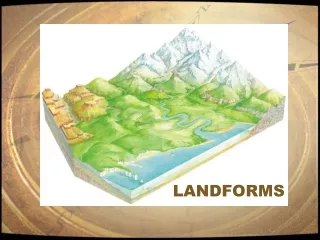
Landforms • The solid features formed on Earth’s crust. • Other features include bodies of water. • Crustal movement and other tectonic activity inside Earth create • landforms; mountains, faults, sinks, and volcanos. • Many landforms are shaped by water and wind that carve and erode • land surfaces, carrying and depositing soil, sand and other debris.
Topographic maps and models are used to represent landforms and help scientists better understand objects and processes.
archipelago • ahr-kuh-pel-uh-gohA group or chain of islands in a large body of water Back to Landform Chart
bay • A bay is a body of water that is partly enclosed by land (and is usually smaller than a gulf). Back to Landform Chart
butte • A butte is a flat-topped rock or hill formation with steep sides. Back to Landform Chart
canyon • A canyon is a deep valley with very steep sides - often carved from the Earth by a river. Back to Landform Chart
cape • A cape is a pointed piece of land that sticks out into a sea, ocean, lake, or river. Back to Landform Chart
peninsula • A peninsula is a LARGER body of land that is surrounded by water on three sides Back to Landform Chart
channel • A channel is a body of water that connects two larger bodies of water (like the English Channel). A channel is also a part of a river or harbor that is deep enough to let ships sail through Back to Landform Chart
strait and canal Canal- A constructed channel filled with water used for navigation, irrigation, or drainage. Strait- A passageway of water connecting two large bodies of water. Back to Landform Chart
delta • A delta is a low, watery land formed at the mouth of a river. It is formed from the silt, sand and small rocks that flow downstream in the river and are deposited in the delta. A delta is often (but not always) shaped like a triangle (hence its name, delta, a Greek letter that is shaped like a triangle). Back to Landform Chart
desert • A desert is an area that receives less than 10 inches of rain per year and where there is little to no vegetation. Back to Landform Chart
oasis • a fertile or green area in an arid region (as a desert) Back to Landform Chart
dune • A dune is a hill or a ridge made of sand. Dunes are shaped by the wind, and change all the time Back to Landform Chart
estuary • An estuary is where a river meets the sea or ocean. Back to Landform Chart
fjord • A fjord is a long, narrow sea inlet that is bordered by steep cliffs. Back to Landform Chart
geyser • A geyser is a natural hot spring that occasionally sprays water and steam above the ground. Back to Landform Chart
glacier • A glacier is a slowly moving river of ice. Back to Landform Chart
gulf • A gulf is a part of the ocean (or sea) that is partly surrounded by land (it is usually larger than a bay). Back to Landform Chart
hill • A hill is a raised area or mound of land. Back to Landform Chart
island • An island is a piece of land that is surrounded by water. Back to Landform Chart
isthmus • An isthmus is a narrow strip of land connecting two larger landmasses. An isthmus has water on two sides. Back to Landform Chart
lagoon • A lagoon is a shallow body of water that is located alongside a coast. Back to Landform Chart
lake • A lake is a large body of water surrounded by land on all sides. Really huge lakes are often called seas. Back to Landform Chart
marsh • A marsh is a type of freshwater, brackish water or saltwater wetland that is found along rivers, pond, lakes and coasts. Marsh plants grow up out of the water. Back to Landform Chart
mesa • A mesa is a land formation with a flat area on top and steep walls - usually occurring in dry areas. Back to Landform Chart
mountain • A mountain is a very tall high, natural place on Earth - higher than a hill. The tallest mountain on Earth is Mt. Everest. Back to Landform Chart
ocean • An ocean is a large body of salt water that surrounds a continent. Oceans cover more the two-thirds of the Earth's surface Back to Landform Chart
plain • Plains are flat lands that have only small changes in elevation Back to Landform Chart
plateau • A plateau is a large, flat area of land that is higher than the surrounding land. Back to Landform Chart
pond • A pond is a small body of water surrounded by land. A pond is smaller than a lake. Back to Landform Chart
prairie • A prairie is a wide, relatively flat area of land that has grasses and only a few trees. Back to Landform Chart
river • A river is a large, flowing body of water that usually empties into a sea or ocean. Back to Landform Chart
sea • A sea is a large body of salty water that is often connected to an ocean. A sea may be partly or completely surrounded by land. Back to Landform Chart
sound • A sound is a wide inlet of the sea or ocean that is parallel to the coastline; it often separates a coastline from a nearby island Back to Landform Chart
source • A source is the beginning of a river. Back to Landform Chart
swamp • A swamp is a type of freshwater wetland that has spongy, muddly land and a lot of water. Many trees and shrubs grow in swamps. Back to Landform Chart
tributary • A tributary is a stream or river that flows into a larger river. Back to Landform Chart
tundra • A tundra is a cold, treeless area; it is the coldest biome. Back to Landform Chart
valley • A valley is a low place between mountains. Back to Landform Chart
volcano • A volcano is a mountainous vent in the Earth's crust. When a volcano erupts, it spews out lava, ashes, and hot gases from deep inside the Earth. Back to Landform Chart
waterfall • When a river falls off steeply, there is a waterfall. Back to Landform Chart
reef • Ridge of sand, rock, or coral that lies at or near the surface of a sea or ocean. Back to Landform Chart
savanna • An area of grassland and scattered trees. Back to Landform Chart