Download

1 / 21
210 likes | 334 Vues
This foundational course in modeling introduces participants to key concepts such as defining and formulating purposes, identifying entities, choosing relations, and conceptualizing models. Participants will explore the importance of SMART criteria in determining Category II quantities, focusing on specific, measurable, acceptable, realistic, and timely outcomes. The course emphasizes the significance of operationalization in quantifying diverse factors like energy consumption and waste production. Engage with practical examples, quizzes, and discussions aimed at developing robust models that cater to stakeholders' needs.

E N D
A core Course on Modeling Introductionto Modeling 0LAB0 0LBB0 0LCB0 0LDB0 c.w.a.m.v.overveld@tue.nl v.a.j.borghuis@tue.nl S.23
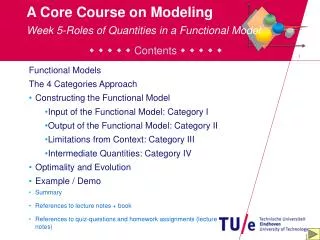
define formulate purpose identify entities choose relations conceptualize formalize relations obtain values formalize operate model obtain result execute present result interpret result conclude Executionphase: operate model
The model function maps decisions (=valuesfor cat.-I quantities) totheirconsequencesfor the stakeholders. Everything the model shouldyieldfor stakeholders, is a criterion on cat.-II quantities. http://cdn.morguefile.com/imageData/public/files/m/mconnors/preview/fldr_2003_12_31/file0001135069634.jpg
Don’tincludetoomany cat.-II quantities; • because ... • lumping: toomanydubiousweight factors • no lumping: see next lecture • Include the right cat.-II quantities; • Cat.-II quantitiesfor design etc. must beordinal; • Cat.-II quantities must be SMART. • S = specific • M = measurable • A = acceptable • R = realistic • T = timely
Regarding SMART-ness: Even ‘hard’ quantities (e.g., energy consumption, waste production, noise, …) oftenrequire non-trivialoperationalization. http://www.clipartlord.com/wp-content/uploads/2013/07/snail3-240x240.png example of operationalization: what is the energy consumption of a washing machine? http://www.clipartlord.com/category/home-clip-art/appliances-clip-art/washing-machine-clip-art/
Regarding SMART-ness: Even ‘hard’ quantities (e.g., energy consumption, waste production, noise, …) oftenrequire non-trivialoperationalization. QUIZ • Whatwouldbe the consequences of optimizing a washing machine with respect to ... • joule/Hour • joule/wash • joule/(kg wash) • joule/(lifetime of a piece of laundry) • joule/(lifetime of the washing machine)? http://www.clipartlord.com/wp-content/uploads/2013/07/snail3-240x240.png example of operationalization: what is the energy consumption of a washing machine? http://www.clipartlord.com/category/home-clip-art/appliances-clip-art/washing-machine-clip-art/
Regarding SMART-ness: Even ‘hard’ quantities (e.g., energy consumption, waste production, noise, …) oftenrequire non-trivialoperationalization. http://www.clipartlord.com/wp-content/uploads/2013/07/snail3-240x240.png example of operationalization: what is the energy consumption of a washing machine? • Joule/Hour? http://www.clipartlord.com/category/home-clip-art/appliances-clip-art/washing-machine-clip-art/
Regarding SMART-ness: Even ‘hard’ quantities (e.g., energy consumption, waste production, noise, …) oftenrequire non-trivialoperationalization. http://www.clipartlord.com/wp-content/uploads/2012/12/red-socks-300x269.png example of operationalization: what is the energy consumption of a washing machine? • Joule/Hour? • Joule/wash? http://www.clipartlord.com/category/home-clip-art/appliances-clip-art/washing-machine-clip-art/
Regarding SMART-ness: Even ‘hard’ quantities (e.g., energy consumption, waste production, noise, …) oftenrequire non-trivialoperationalization. http://www.clipartlord.com/wp-content/uploads/2012/11/fireman-259x300.png example of operationalization: what is the energy consumption of a washing machine? • Joule/Hour? • Joule/wash? • Joule/(kg wash)? http://www.clipartlord.com/category/home-clip-art/appliances-clip-art/washing-machine-clip-art/
Regarding SMART-ness: Even ‘hard’ quantities (e.g., energy consumption, waste production, noise, …) oftenrequire non-trivialoperationalization. http://www.clipartlord.com/wp-content/uploads/2013/07/meat-grinder-227x240.png example of operationalization: what is the energy consumption of a washing machine? • Joule/Hour? • Joule/wash? • Joule/(kg wash)? • Joule/(lifetime of the piece of laundry)? http://www.clipartlord.com/category/home-clip-art/appliances-clip-art/washing-machine-clip-art/
Regarding SMART-ness: Even ‘hard’ quantities (e.g., energy consumption, waste production, noise, …) oftenrequire non-trivialoperationalization. example of operationalization: what is the energy consumption of a washing machine? • Joule/Hour? • Joule/wash? • Joule/(kg wash)? • Joule/(lifetime of the piece of laundry)? • Joule/(lifetime of the washing machine)? http://www.clipartlord.com/wp-content/uploads/2012/11/nuclear-explosion-249x300.png http://www.clipartlord.com/category/home-clip-art/appliances-clip-art/washing-machine-clip-art/
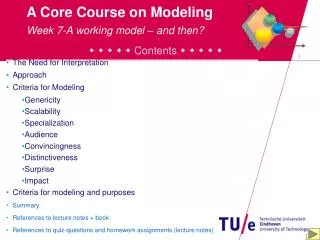
Cat.-II quantitiesand requirements, desires, wishes Terminology: proposition=sentencethat is true or false(‘tomato is red’); predicate=proposition over a concept (‘isRed(tomato)=true’); Requirement=predicateover a concept thatneedstohold; Desire=predicateover a concept that is appreciated. http://www.morguefile.com/archive/display/108211
Cat.-II quantitiesand requirements, desires, wishes A thirdcondition-type is the wish: ‘cat.-II quantity q shouldbe as large (small) as possible’. This, however, is impossibletoachieve: itwouldrequireallpossibleoutcomestocompare with. Weakerversion: ‘q shouldapproximate the max (min) as achievable in the cat.-I space’.
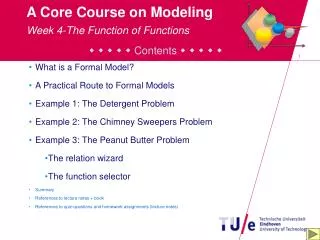
Example: an evening in the bar • E=MSM+MSF;euromoney spent: should be minimal • L=L0-(Q*R+GTT);minute lonely minutes: should be minimal • MSF=P*V*R*cons;euromoney spent on rounds • cons=1;glass/friend.round http://www.morguefile.com/archive/display/803730
Example: an evening in the bar • E=MSM+MSF;euromoney spent: should be minimal • L=L0-(Q*R+GTT);minute lonely minutes: should be minimal • MSF=P*V*R*cons;euromoney spent on rounds • cons=1;glass/friend.round QUIZ http://www.morguefile.com/archive/display/803730 What is expressedbycons=1 ? Whathappensif we leave out the factor consfrom MSF=P*V*R*cons?
Example: an evening in the bar • E=MSM+MSF;euromoney spent: should be minimal • L=L0-(Q*R+GTT);minute lonely minutes: should be minimal • MSF=P*V*R*cons;euromoney spent on rounds • cons=1;glass/friend.round • one friend gets one drink in one round • MSM=P*G;euromoney spent on drinking alone • P=2.25;Euro/glass price of one drink • V=7;friend nr of friends http://www.morguefile.com/archive/display/803730
Example: an evening in the bar • R=0 ... 10;round nr rounds I buy • G=0 ... 20;glass nr of drinks I buy for myself • Q=15;minute/round amount of talk time per round • L0=360;minute length of an evening • GTT=max(zero,maxTalkTime*(optNrGlasses2- (G-optNrGlasses)2)/optNrGlasses2) http://www.morguefile.com/archive/display/803730
Example: an evening in the bar • R=0 ... 10;round nr rounds I buy • G=0 ... 20;glass nr of drinks I buy for myself • Q=15;minute/round amount of talk time per round • L0=360;minute length of an evening • GTT=max(zero,maxTalkTime*(optNrGlasses2- (G-optNrGlasses)2)/optNrGlasses2) http://www.morguefile.com/archive/display/803730 QUIZ GTT represents talk time duetomyownconsumption of alcohol. How does GTT depend on G? Why do we want that?
Example: an evening in the bar • R=0 ... 10;round nr rounds I buy • G=0 ... 20;glass nr of drinks I buy for myself • Q=15;minute/round amount of talk time per round • L0=360;minute length of an evening • GTT=max(zero,maxTalkTime*(optNrGlasses2- (G-optNrGlasses)2)/optNrGlasses2)amount of time I can talkdepening on what I drink • That is: howmyeloquencedepends on nr drinks I had. http://www.morguefile.com/archive/display/803730
Example: an evening in the bar • maxTalkTime=63;minute max talk time if I drink exactly enough • optNrGlasses=3;glass optimal number of glasses for me to drink • zero=0;minute to make GTT dimensionally correct • Notice: • cons=1 and zero=0 are necessaryto make dimensions match http://www.morguefile.com/archive/display/803730
Summary: choose cat.-II definitions with care threevarieties of directionsforoptimality • requirement (must have) • desire (nice-to-have) • wish (unbounded: ‘as ... as possible’) • needforvalue-less, but not unit-less factors or terms in expresions