Our Solar System
Discover fascinating facts about our Solar System, from the rocky asteroids situated between Mars and Jupiter to the dazzling array of planets. Learn how the density, moons, and sizes differ between terrestrial and jovian planets, and delve into the orbits of these celestial bodies. Understand Kepler's Second Law and the differences between geocentric and heliocentric models. Whether it's the longest day on Venus or the longest year on Neptune, uncover the mysteries that govern our cosmic neighborhood.
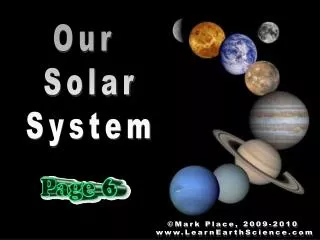

Our Solar System
E N D
Presentation Transcript
Our Solar System ©Mark Place, 2009-2010 www.LearnEarthScience.com
Asteroids rocky objects with round or irregular shapes lie in a belt between Mars and Jupiter The total mass of all the asteroids is less than that of the Moon.
only visible when they are close to the sun
Draw a line across the table between the terrestrial and jovian planets and label.
Which are more dense? Jovian or terrestrial
Which have more moons? Jovian or terrestrial
Which have longer periods of revolution? Jovian or terrestrial
Which are larger in size on average? Jovian or terrestrial
How are the orbits of the planets described? slightly, eccentric ellipse eccentricity website
Which planet has the least perfectly circular orbit? Mercury
Which planet has the most perfectly circular orbit? Venus
Calculate the eccentricity of the ellipse below: length of major axis Formula: eccentricity = distance between foci length of major axis
When does a planet move slowest in its orbit? When furthest from Sun When does a planet move fastest in its orbit? When closest to Sun
Kepler's Second Law Area A = Area B = Area C eccentricity website
Explain the difference between the geo- and helio-centric models of the solar system. Helio-centric Geo-centric Earth- centered Sun- centered