Download
1 / 2
20 likes | 141 Vues
This paper investigates the structure of quarks and leptons within compositeness models, positing that they are bound states of “preons,” which can consist of three fermions or a combination of fermion and boson. We predict a variety of excited states and specifically analyze singly produced excited electrons (e*) through Contact Interaction (CI) and their decay via Gauge Mediated (GM) processes. Focusing on three promising GM decay modes, we derive new limits on excited electron masses and compositeness scales based on recent experimental data.

E N D
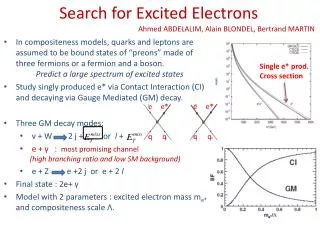
Search for Excited Electrons Ahmed ABDELALIM, Alain BLONDEL, Bertrand MARTIN • In compositeness models, quarks and leptons are assumed to be bound states of “preons” made of three fermions or a fermion and a boson. Predict a large spectrum of excited states • Study singly produced e* via Contact Interaction (CI) and decaying via Gauge Mediated (GM) decay. • Three GM decay modes: • ν + W 2 j + or l + • e + γ : most promising channel (high branching ratio and low SM background) • e + Z e +2 j or e + 2 l • Final state : 2e+ γ • Model with 2 parameters : excited electron mass me* and compositeness scale Λ. e e* e e* q q q q Single e* prod. Cross section
Previous Limits : • LEP, HERA : me* > 300 GeV • CDF : me* > 879 GeVfor Λ= me* • DØ : me*> 796 GeVfor Λ = me* • Backgrounds : • Physics : Z+ γ • Jets faking e/γ:Z+Jet, W+ γ, W+Jet, diboson, QCD ....(will be included later) Excl. 95% CL me*=1TeV, Λ= 5TeV Reco. meeγ Reco. meγ