SCUD Model Tracks Tsunami Driftage
10 likes | 125 Vues
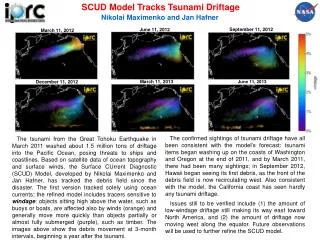
The SCUD Model developed by Nikolai Maximenko and Jan Hafner has provided valuable insights into the driftage of debris from the Great Tohoku Earthquake's tsunami. The model forecasts have aligned with confirmed sightings along the coasts of Washington, Oregon, and Hawaii, beginning with debris washing ashore at the end of 2011. Future analyses aim to explore the ongoing movement of low-windage driftage and its impact on shipping and coastal environments, enhancing our understanding and predictions regarding oceanic debris dispersal.


SCUD Model Tracks Tsunami Driftage
E N D
Presentation Transcript
SCUD Model Tracks Tsunami Driftage Nikolai Maximenko and Jan Hafner September 11, 2012 June 11, 2012 March 11, 2012 March 11, 2013 December 11, 2012 June 11, 2013 The confirmed sightings of tsunami driftage have all been consistent with the model’s forecast: tsunami items began washing up on the coasts of Washington and Oregon at the end of 2011, and by March 2011, there had been many sightings; in September 2012, Hawaii began seeing its first debris, as the front of the debris field is now recirculating west. Also consistent with the model, the California coast has seen hardly any tsunami driftage. Issues still to be verified include (1) the amount of low-windage driftage still making its way east toward North America, and (2) the amount of driftage now moving west along the equator. Future observations will be used to further refine the SCUD model. The tsunami from the Great Tohoku Earthquake in March 2011 washed about 1.5 million tons of driftage into the Pacific Ocean, posing threats to ships and coastlines. Based on satellite data of ocean topography and surface winds, the Surface CUrrent Diagnostic (SCUD) Model, developed by Nikolai Maximenko and Jan Hafner, has tracked the debris field since the disaster. The first version tracked solely using ocean currents; the refined model includes tracers sensitive to windage: objects sitting high above the water, such as buoys or boats, are affected also by winds (orange) and generally move more quickly than objects partially or almost fully submerged (purple), such as timber. The images above show the debris movement at 3-month intervals, beginning a year after the tsunami.