Understanding Sound Waves: Concepts of Compression, Pitch, and the Doppler Effect
This article explores the nature of sound as a sequence of pressure waves that travel through various media like air and water. It explains key concepts like compression (areas of maximum pressure) and rarefaction (areas of minimum pressure), how pitch is determined by frequency, and the fascinating Doppler Effect, which describes how sound frequency changes with the motion of an observer. Additionally, it discusses resonance, highlighting its critical role in vibration systems, using the Tacoma Narrows Bridge collapse as a historical example.


Understanding Sound Waves: Concepts of Compression, Pitch, and the Doppler Effect
E N D
Presentation Transcript
Sound Waves By Willie Hustead
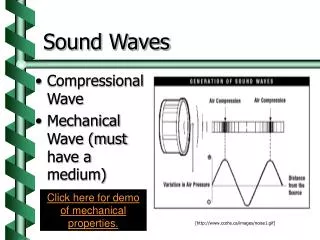
What is sound? • Sound is a sequence of waves of pressure that travel through media such as air or water that is able to compress easily.
Compression and rarefaction • Compression is the region of a wave in which the density and pressure are at a maximum. • Rarefaction is the region of a wave in which the density and pressure are at a minimum.
Pitch • Pitch is a measure of how high or low a sound is perceived to be, depending on the frequency of the sound wave. Frequency is defined as the number of cycles per unit of time.
The Doppler Effect! • The Doppler Effect, named after Austrian psyicist Christian Doppler, is the change in frequency of a wave for an observer moving relative to a wave. Such as when a fire engine drives by, the siren is higher before and when it reaches a person, and lower when it passes by. • http://upload.wikimedia.org/wikipedia/commons/9/90/Dopplerfrequenz.gif
Resonance • A phenomenon that occurs when the frequency of a force applied to a system matches the natural frequency of vibration of the system, resulting in a large amplitude of vibration. • On November 7, 1940, high winds caused the Tacoma Narrows suspension bridge to start resonating and eventually collapse.