Understanding Photosynthesis and the Role of Autotrophs in Energy Production
This comprehensive overview explains the process of photosynthesis, a crucial biological function where autotrophs, or producers like plants and algae, convert sunlight into food. It differentiates between autotrophs and heterotrophs, highlighting their roles in ecosystems. Key processes such as respiration, ATP production, and the structure of chloroplasts involved in photosynthesis are discussed. Additionally, the light-dependent and light-independent reactions and factors affecting the rate of photosynthesis are analyzed.

Understanding Photosynthesis and the Role of Autotrophs in Energy Production
E N D
Presentation Transcript
What are autotrophs? • Why are they important?
Energy for Life • AUTOTROPHS are organisms that can make their own food. • Also called PRODUCERS. • Ex. PLANTS, ALGAE
Energy for Life • HETEROTROPHS are organisms that depend on other organisms for food. • Also called CONSUMERS. • Ex. ANIMALS, BACTERIA
Energy for Life • TWO biological processes are needed to create usable energy for organisms. • Photosynthesis– the process that converts sunlight into sugar. (autotrophs only) • Respiration – process that releases energy in sugar into usable energy for cells. (autotrophs and heterotrophs)
ATP • Adenosine triphosphate (ATP) – energy storage molecule. Adenine (nitrogen base) Ribose (sugar) 3 Phosphate groups
ATP ADP + phosphate + energy (tri) (di) ATP • ATP is the universal currency for energy • ATP stores energy in the BONDS BETWEEN THE PHOSPHATE GROUPS. • When a BOND IS BROKENenergy is released.
Structure of a Chloroplast • A chloroplast is the structure in a plant cell where photosynthesis occurs. Internal Structure: • Thylakoid membrane –internal membrane, look like stacks of pancakes. • Lumen – space inside thylakoid membrane. • Grana –stacks of thylakoids. • Stroma – solution that thylakoids are embedded in.
Pigments • Pigments are light absorbing molecules. • Each pigment absorbs and reflects different wavelengths of light. (we see the reflected color)
Pigments • CHLOROPHYLL is the primary pigment in photosynthesis. • Gives plants their GREEN color. • CAROTENOIDS are accessory pigments that absorb light that chlorophyll cannot. • They are YELLOW, ORANGE, AND BROWN.
Checkpoint • Why do leaves turn yellow, orange and brown in the fall? • Production of chlorophyll is slowed down in the fall due to lower temperatures and less sunlight!
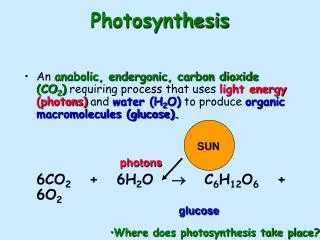
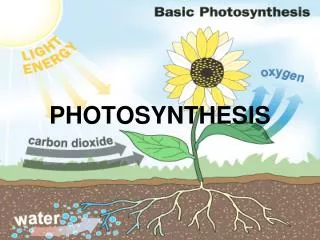
6 CO2 + 6 H2O + sunlight C6H12O6 + 6O2 Photosynthesis song :) Photosynthesis Sunlight Glucose Carbon Dioxide Oxygen Water
Van Helmont • Measured plant mass and soil mass before and after 5 years of growth • Most of gain in mass came from water
Priestly • Candle with a jar over it would die out • Required oxygen • Sprig of mint plus candle caused candle to last longer • Plant produced oxygen
Ingenhousz • Effect showed by Priestly occurred only in the presence of light
Photosynthesis • There are two stages to photosynthesis, the light-dependent reactions and light-independent (dark) reactions. Photosynthesis video
Light-dependent Reactions • Occur in the THYLAKOID MEMBRANES. • Light is absorbed by chlorophyll in Photosystem II and electrons are excited. • The excited electrons move through a series of reactions – the electron transport chain.
Light-dependent Reactions • The light energy splits water molecules into H and O2 • The O2 is released into the atmosphere and the H bonds to a carrier molecule (NADPH) to be carried to the Dark Reactions. • Splitting the water also creates ATP.
Sunlight, water, and CO2 Chloroplast Light- dependent Reactions Light Reactions Chloroplast Light Reactions ATP ATP ATP NADPH NADPH NADPH O2 The end products of the light reactions are NADPH, ATP, and O2
Melvin Calvin Light-independent Reactions • Don’t Require LIGHT • Also called the DARK REACTIONS OR THE CALVIN CYCLE. • Occur in the STROMA
Light-independent Reactions • Carbon dioxide enters the plant and attaches to a sugar molecule. • This is called carbon fixation • Carbon Dioxide, NADPH, and ATPcombine with enzymes to make glucose (C6H12O6) and more CO2.
Light, water, and CO2 Carbon Fixation ATP NADPH+H O2 Dark Reactions CO2 Chloroplast Chloroplast NADP+ ADP + P Light- independent Reactions Light- dependent Reactions Glucose
Factors Affecting Photosynthesis • Light Intensity– the more light the faster the rate of photosynthesis. • CO2 Concentration– the more CO2, the faster the rate of photosynthesis. • Temperature – rate of photosynthesis slows down at extremes of hot or cold. Photosynthesis video