Essential Nutrition and Hydration Guidelines for Optimal Strength and Performance
Discover vital nutrition and hydration strategies to enhance athletic performance. This guide emphasizes increasing protein and carbohydrate intake while maintaining appropriate hydration levels. With specific recommendations for daily food intake, including proteins from tuna, chicken, and protein shakes, and complex carbs from whole grains and vegetables, you'll learn how to fuel your body effectively. Additionally, find essential hydration tips to avoid under or overhydration, ensuring optimal performance. Avoid nutraceuticals and focus on whole foods for best results.

Essential Nutrition and Hydration Guidelines for Optimal Strength and Performance
E N D
Presentation Transcript
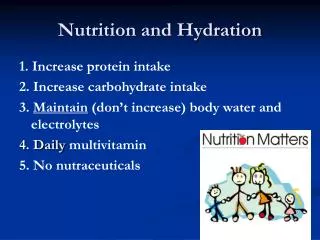
Nutrition and Hydration 1. Increase protein intake 2. Increase carbohydrate intake 3. Maintain (don’t increase) body water and electrolytes 4. Daily multivitamin 5. No nutraceuticals
Nutrition - the Big Three Proteins: Building blocks for muscle Energy Carbohydrates : Energy Fats: Energy
Protein • Functions • Essential building blocks of lean tissue • Muscle, blood cells, hormones, bone, enzymes, etc. • Secondary energy source • Made up of 20 amino acids
How Much Protein Do I Need for Maximum Strength Increase? 0.8 gm/pound of body wt/day 140 gms for 175 lb student)
Where Do I get 140 grams of Protein From? • Tuna - approx 8 gms/oz • Chicken - approx 8 gms/oz • Protein bars - approx 30 gms • Protein shakes - approx 16 gms
Carbohydrates • Complex Carbs • Examples • Whole grains, fruits, vegetables, brown rice, etc • Longer to break down than simple carbs • Result in lower insulin response than simple carbs • Fiber • Insoluble – does not dissolve in water • Soluble – dissolves in water
Fat • 20-25% of total diet, not more than 30% • Most concentrated form of energy • Types of fat • Unsaturated • Mono • Poly • Saturated (limit intakes) • Trans (limit intakes)
Grains 6oz. everyday Vegetables 2.5 cups everyday Fruits 2 cups everyday Milk 3 cups everyday Meats & Beans 5.5 oz. everyday Fats Limit intake Mostly from fish, nuts, vegetable oils Limit butter, margarine, shortening, and lard Sugar and Salt Limit intakes USDA Recommendations
Hydration - the Basics • You lose about 2-3 liters of water a day in urine and breathing • You lose about 500cc of water an hour when in the water • You lose about a liter an hour sweating during strenuous athletic events in warm weather
Rehydration - How to Do It Right • Baseline of 3 liters a day • An extra liter of water for every two hours in the water • An extra liter of water for every hour of PT/Runs • Don’t be thirsty but don’t overhydrate • Keep your urine clear • Alternate water with energy/electrolyte drink when possible
Rehydration - If you get it Wrong Too LITTLE Water Decreased athletic performance Heat Stroke Dropped from Training
Rehydration - If you get it Wrong Too MUCH Water Bloating Urinary frequency Immersion Pulmonary Edema Convulsions and death possible
How to lose weight • NOT AS EASY AS GAINING WEIGHT! • Diet • Exercise • Weight training • Cardio • Physical Activity • Combined Effort (4 pronged approach)
Substances to Avoid • Anabolic steroids • Ephedrine • Ma Huang • DHEA/Androstendione • Chromium Picolinate • Creatine • Hydroxymethylbutyrate (HMB) • Alcohol
Nutraceuticals Definition: Non - nutrient substances alleged to have some beneficial athletic or body-building effect Warning! It’s not about making you a better athlete. It’s about making them money.
What does that mean about Alcohol? • Fat + Alcohol will be turned into Fat • Carbs and Protein can contribute to Fat increase…but not directly as most believe • When considering a diet…need to consider Alcohol…
Once Again: The Right Way 1. Increase protein intake 2. Increase carbohydrate intake 3. Maintain (don’t increase) body water and electrolytes 4. Daily multivitamin 5. No nutraceuticals