Download
1 / 1
10 likes | 120 Vues
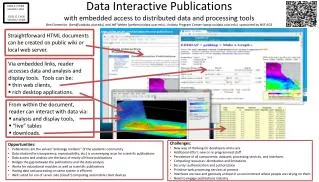
This project explores a new paradigm for scientific publications by integrating interactive data access and analysis tools directly within HTML documents. Readers can engage with datasets through embedded links, enabling real-time interactions, live tables, and downloads. While this approach presents challenges in terms of development, security, and resource limitations, it offers significant opportunities for enhancing academic communications, promoting data citations, and bridging the gap between publications and data analysis. This model is well-suited for cloud computing and mobile applications, facilitating efficient educational and scientific endeavors.

E N D
ESSI2.4 / XY409 EGU2012-1552 Data Interactive Publications with embedded access to distributed data and processing toolsBen Domenico (ben@unidata.ucar.edu) and Jeff Weber (jweberunidata.ucar.edu), Unidata Program Center (www.unidata.ucar.edu), sponsored by NSF AGS ESSI2.12 / XL50 EGU2012-13464 https://sites.google.com/site/datainteractivepublications/ • Straightforward HTML documents can be created on public wiki or local web server. • Via embedded links, reader accesses data and analysis and display tools. Tools can be: • thin web clients, • rich desktop applications. • From within the document, reader can interact with data via: • analysis and display tools, • “live” tables • downloads. • Challenges: • New way of thinking for developers and users • Additional effort: new or re-programmed staff • Persistence of all components: datasets, processing services, and interfaces • Computing resources: distribution and limitations • Security: authentication and authorization • Primitive web processing services at present • Interfaces are new and generally untried in an environment where people are relying on them • Need to engage publications industry • Opportunities: • Publications are the valued “exchange medium” of the academic community • Data citation (for transparency, reproducibility, etc.) is an emerging issue for scientific publications • Data access and analysis are the basis of nearly all those publications • Bridges the gap between the publications and the data analysis • Works for educational modules as well as scientific publications • Having data and processing on same system is efficient. • Well suited for era of server side (cloud?) computing and mobile client devices