Betrayal and Tragedy: Julius Caesar's Untimely End
Delve into the political turmoil of ancient Rome as Shakespeare's iconic play unfolds the conspiracy against Julius Caesar. Witness the power struggles, betrayals, and fate that lead to a dramatic climax. Explore themes of loyalty, ambition, and honor in this timeless tragedy.

Betrayal and Tragedy: Julius Caesar's Untimely End
E N D
Presentation Transcript
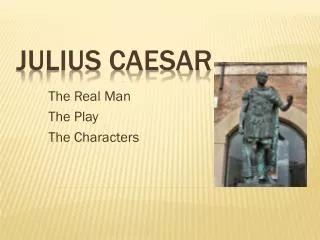
Julius Caesar by William Shakespeare
Beware the Ides of March! Soothsayer • Julius Caesar was assassinated March 15th, 44 BC
Roman Calendar • The Roman calendar used to begin in March but was later changed to January 1st. • The month of March was named to honor Mars the god of war.
Setting: • Rome, Italy • 44 BC • Time of Julius Caesar
Conflict: • There were some who believed Caesar was a tyrant and would abuse his power.
Act I Expostion • Begins Feb 15th • Feast of Lupercal • Caesar’s triumphant march through Rome • Pompey is defeated
Act I Conflict • Marullus and Flavius(tribunes) are angry over Pompey’s defeat.
Quotation • “O you hard hearts, you cruel men of Rome, knew you not Pompey? … Be gone!” Marullus, Act I , sc I The Roman commoners (Plebians) are fickle and changeable in their loyalty to their leaders.
Protagonists: • Cassius: leader of the conspiracy, hates Caesar, feels Caesar is weak • Brutus: sees himself as honorable but is troubled by the growing power of Caesar
Protagonists: cont… • Mark Antony: Loyal friend to Caesar, opposes the conspiracy, becomes a future leader of Rome
Act I, sc ii notes • Caesar has epilepsy and is deaf in one ear. • Caesar is suspicious of Cassius. • “Yond Cassius has a lean and hungry look. Such men are dangerous…”
Caesar has a Seizure • Antony offers Caesar the Lupercal coronet 3 times. • Each time Caesar refuses. • On the 3rd time, Caesar falls and has a seizure. The crowd laughs and mocks him although they cheered for him to take the crown.
Soliloquy: • A speech made by a lone actor on stage who speaks his thoughts aloud.
Cassius’ Soliloquy: • False letters are sent to Brutus’ home asking him to defend the Roman people from Caesar’s rule.
Act I, sc iii notes March 14th, 44 BC • Stormy, ominous night Omens/Foreshadowing • pg 900 • Cicero is unwilling to participate in the conspiracy
Animal Symbols • Caesar is compared to a • Lion • Wolf • Serpent • Explain these symbols.
Quotation/Animal Imagery • “I know he [Caesar] would not be a wolf • But that he sees Romans but as sheep; He were no lion, were not Romans hinds.” • Act I, sc iii
Conspirators’ Plans • Meet at Pompey’s Porch • Go to Brutus’ house • Include Brutus in the conspiracy
Foil • Brutus vs Cassius • Identify 4 or more contrasting characteristics from Act I
Cassius Enemy to Caesar Mastermind Brutus Friend to Caesar Public Face Foil: Character Contrast
Act II Rising Action • The conspirators meet at Brutus’ home early on the morning of the ides of March to discuss the assassination.
Act II notes • Brutus is disturbed by letters he has found at his home.
Brutus’s Soliloquy • Brutus has internal conflict about the conspiracy: • “I know no personal cause to spurn at him, • But for the general.”
Metaphor/Soliloquy • “And therefore think him as a serpent’s egg… and kill him in his shell.”
Brutus’ Decisions • Brutus will not let Cicero be included in the conspiracy. • Brutus will not let Mark Antony be killed with Caesar.
Definition • anachronism • (pg. 981) • and locate an example • on page 917.
Female Characters: • Portia: wife to Brutus • Calpurnia: wife to Caesar
Portia • How does Portia prove her loyalty to Brutus? • Who is Portia’s father? Read the side note. • Will Brutus tell Portia his secrets?
Act II, sc ii notes • Home of Caesar • Caesar is portrayed as vain and arrogant. • He ignores many warnings.
Calpurnia’s Dream • “She dreamt tonight she saw my statue, • Which, like a fountain with an hundred spouts,
Dream cont… • “…Did run pure blood, and many lusty Romans Came smiling and did bathe their hands in it.”
Decius’ Manipulation • Decius re-interprets Calpurnia’s dream. • Decius states the senate will offer the crown. • Decius implies Caesar is weak and cowardly and controlled by his wife.
Scene iii • Artemidorus is a teacher who plans to write a letter to warn Caesar.
Warnings/Foreshadowing • Soothsayer • Calphurnia’s dream • Reports of nature in chaos • Augurers/Priests • Artemidorus the teacher
Scene IV: Portia • Portia’s anxiety shows she knows Brutus’ plan • Lucius is concerned about what he is to report • The soothsayer plans to warn Caesar again. • Rising Action: Adds suspense!
Climax • Assassination of JC • Mark Antony’s • speech to the people (pg 950-951)
Assassination Plan • Metullus makes a request that Caesar will deny: the return of his banished brother • All the conspirators make this request while surrounding Caesar
Caesar’s Response • “Hence! Wilt thou lift up Olympus?” • “…I am as constant as the Northern Star”
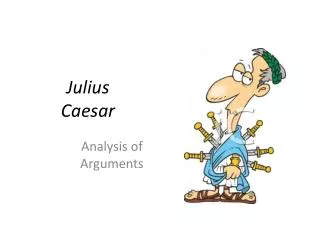
Caesar’s Response • Final dying words: • ”Et tu Brute? Then fall Caesar.”
Aftermath… • Antony swears vengeance on the conspirators. • He will make friends with them to speak at Caesar’s funeral.
Antony’s Soliloquy • “O pardon me thou bleeding piece of earth, That I am meek and gentle with these butchers!”
Antony’s Prophesy • “A curse shall light upon the limbs of men; Domestic fury and fierce civil strife Shall cumber all the parts of Italy.”
Caesar’s funeral • Brutus allows Antony to speak at the funeral. • Antony shall speak after Brutus and shall not speak against the conspirators.
New Character • Octavius-Caesar’s nephew and heir • The next emperor of Rome
Brutus’ Speech to the People • “Not that I loved Caesar less, but that I loved Rome more.” • “…as he was ambitious, I slew him.”
Antony’s Speech: Rhetoric • Examples: repetition, verbal irony, sarcasm, emotional appeal, logical appeal, reverse psychology
Repetition/Irony • “For Brutus is an honorable man…so are they all, all honorable men.”
Persuasion • Emotional Appeal: • “…for Brutus, as you know, was Caesar’s angel.”