Informative Speeches
Chapter 15 Recap/Lecture. Informative Speeches. Purpose. To inform; not to advocate Goal is to provide understanding and knowledge. Types of Informative Speeches. Speeches about objects Speeches about processes Speeches about concepts. General Guidelines. Don’t overestimate or assume

Informative Speeches
E N D
Presentation Transcript
Chapter 15 Recap/Lecture Informative Speeches
Purpose • To inform; not to advocate • Goal is to provide understanding and knowledge
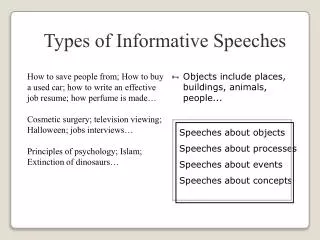
Types of Informative Speeches • Speeches about objects • Speeches about processes • Speeches about concepts
General Guidelines • Don’t overestimate or assume • Don’t be too technical • Be concrete (e.g. language, comparisons, contrasts) • Make the topic interesting • Relate the topic to your audience • Personalize the speech
Next speech • Informative speeches • 3/4 and 3/6 • New focuses: Organization and delivery • More prep time in-class and out-of-class • 4 to 6 minutes • Materials: Keyword outline, visual aid (overhead projector or poster), note cards, and critique sheets • http://www.gordonstate.edu/Faculty/agoldman/Public%20Speaking.htm • Research required: at least 2 sources (with citations) • Still considering past concepts • Central idea: More creative construction of thesis statement
Topic Selection • Must be approved • Must inform and NOT persuade • Speech about a concept, process, or object • Goal is to find a topic that you will also be able to use for your persuasive speech • To build on research • To practice avoiding bias in informative speech • Helps improve skill of informative vs. persuasive speaking
Example • Informative speech topic: Providing understanding about reality television docusoaps • Persuasive speech topic: Persuading my audience not to watch reality television docusoaps because of its detrimental effects