Introduction to Numerical Methods Mathematical Procedures
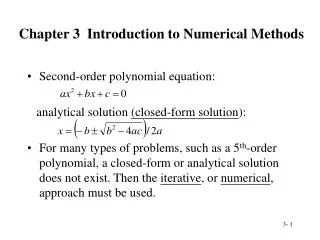
Introduction to Numerical Methods Mathematical Procedures. Mathematical Procedures. Nonlinear Equations Differentiation Simultaneous Linear Equations Curve Fitting Interpolation Regression Integration Ordinary Differential Equations Other Advanced Mathematical Procedures:

Introduction to Numerical Methods Mathematical Procedures
E N D
Presentation Transcript
Mathematical Procedures • Nonlinear Equations • Differentiation • Simultaneous Linear Equations • Curve Fitting • Interpolation • Regression • Integration • Ordinary Differential Equations • Other Advanced Mathematical Procedures: • Partial Differential Equations • Optimization • Fast Fourier Transforms
Nonlinear Equations How much of the floating ball is under water? Diameter=0.11m Specific Gravity=0.6
Nonlinear Equations How much of the floating ball is under the water?
Differentiation What is the acceleration at t=7 seconds?
Differentiation What is the acceleration at t=7 seconds?
Simultaneous Linear Equations Find the velocity profile, given Three simultaneous linear equations
Interpolation What is the velocity of the rocket at t=7 seconds?
What is Interpolation ? Given (x0,y0), (x1,y1), …… (xn,yn), find the value of ‘y’ at a value of ‘x’ that is not given. http://numericalmethods.eng.usf.edu
Interpolants Polynomials are the most common choice of interpolants because they are easy to: • Evaluate • Differentiate, and • Integrate. http://numericalmethods.eng.usf.edu
Newton’s Divided Difference Method Linear interpolation: Given pass a linear interpolant through the data where http://numericalmethods.eng.usf.edu
Example The upward velocity of a rocket is given as a function of time in Table 1. Find the velocity at t=16 seconds using the Newton Divided Difference method for linear interpolation. Figure 2: Velocity vs. time data for the rocket example Table 1: Velocity as a function of time http://numericalmethods.eng.usf.edu
http://numericalmethods.eng.usf.edu Linear Interpolation (contd)
Example The upward velocity of a rocket is given as a function of time in Table 1. Find the velocity at t=16 seconds using the Newton Divided Difference method for quadratic interpolation. Figure 2: Velocity vs. time data for the rocket example Table 1: Velocity as a function of time http://numericalmethods.eng.usf.edu
Quadratic Interpolation (contd) http://numericalmethods.eng.usf.edu
http://numericalmethods.eng.usf.edu Quadratic Interpolation (contd)
http://numericalmethods.eng.usf.edu Quadratic Interpolation (contd)
General Form where Rewriting http://numericalmethods.eng.usf.edu
Example The upward velocity of a rocket is given as a function of time in Table 1. Find the velocity at t=16 seconds using the Newton Divided Difference method for cubic interpolation. Figure 2: Velocity vs. time data for the rocket example Table 1: Velocity as a function of time http://numericalmethods.eng.usf.edu
http://numericalmethods.eng.usf.edu Example The velocity profile is chosen as we need to choose four data points that are closest to
http://numericalmethods.eng.usf.edu Distance from Velocity Profile Find the distance covered by the rocket from t=11s to t=16s ?
http://numericalmethods.eng.usf.edu Acceleration from Velocity Profile Find the acceleration of the rocket at t=16s given that
Regression Thermal expansion coefficient data for cast steel
Integration Finding the diametric contraction in a steel shaft when dipped in liquid nitrogen.
Ordinary Differential Equations How long does it take a trunnion to cool down?