Understanding NER300: Relevant and Ranking Costs in Renewable Energy Projects
10 likes | 128 Vues
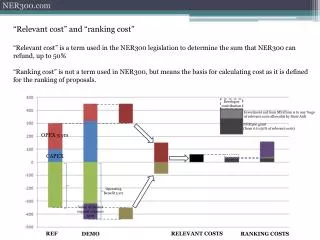
The NER300 legislation outlines the financial framework for funding renewable energy projects through cost reimbursements. "Relevant cost" refers to the sum eligible for refund, capped at 50%, while "ranking cost" provides a basis for evaluating proposals, though it is not formally defined in NER300. This system allows for developer contributions and investment aid from member states, which can vary across relevant costs. Grants can cover up to 50% of these costs, along with operational and capital expenses, influencing the overall financial feasibility of projects.


Understanding NER300: Relevant and Ranking Costs in Renewable Energy Projects
E N D
Presentation Transcript
NER300.com “Relevant cost” and “ranking cost” “Relevant cost” is a term used in the NER300 legislation to determine the sum that NER300 can refund, up to 50% “Ranking cost” is not a term used in NER300, but means the basis for calculating cost as it is defined for the ranking of proposals. Developer contribution Investment aid from MS (from 0 to any %age of relevant costs allowable by State Aid) NER300 grant (from 0 to 50% of relevant costs) OPEX 5 yrs CAPEX Operating Benefit 5 yrs Value of market support schemes 5 yrs REF RELEVANT COSTS DEMO RANKING COSTS