Essential Safety Guidelines for Roadway Extrication Operations
This comprehensive guide outlines the critical safety measures necessary for successful roadway extrication operations. It emphasizes the correct use of protective clothing to safeguard both rescuers and patients. Key points include recognizing hazards such as SRS systems, traffic risks, and environmental factors. The importance of effective communication, crowd control, and vehicle stabilization is also stressed. Rescuers will learn to prioritize patient safety while addressing potential dangers like downed power lines and hazardous materials. Adhering to these guidelines ensures a safer and more efficient extrication process.

Essential Safety Guidelines for Roadway Extrication Operations
E N D
Presentation Transcript
Roadway Extrication General Safety
Proper use of protective clothing Protection of both rescuers and patients Consequences of not protecting patients and rescuers Hazards when exposed to: SRS Vapor recovery fuel systems Sealed drive shafts Hatch-back lifting devices Utility hazards Traffic hazards Determining hazmat presence Vehicle placement Securing of a vehicle Communications necessary during incident 5 considerations for night operations Misc. hazards during the extrication This Section will give the rescuer and understanding of:
Emergency Personnel Safety • Protective clothing must be worn at all times during the rescue • Head: Helmet • Eyes: Goggles or glasses • Body: Turnout or nomex jumpsuits • Hearing: Ear plugs or muffs as required • Body Substance Isolation Equipment • Required at all incidents • Personnel should work within their limits • 20 minutes of effective operation, 10 minutes on heavy exertion
Patient Safety • Physical and mental safety must be addressed equally • Greatest threat may be our mishandling of these • Protect the patient • Noise • Glass • Bare metal • Rocking of vehicles • Falling objects (even rescue equipment) • Use hard and soft coverings • Hard=backboards, helmets • Soft=blankets, fire resistive cloth, aluminized
Crowd Control • Always an issue at an accident scene • Crowd could restrict your activities • May provide bad direction to rescue effort • May provide ignition sources • Theft of property may become an issue • Keep crowd at a distance • Physical barriers • Ropes or barricade tape • Should shield crowd from DOA’s or critically injured when possible
Traffic Control • Controlling the traffic early will reduce problems later • Prevents secondary collisions • Make this an integral part of the hazard control process • Vehicles should be utilized to box off the accident scene • Avoid complete stopping of traffic • Limits access of other responding units
Amperage is the killer 1/10th of an amp is enough to kill Power lines have at least 200 times the killing power necessary 2-8 mili-amps sensation of shock 8-15 m/amps is painful 15-20 m/amps loose control of muscles 20-70 m/amps difficulty breathing 100-200 m/amps v-fib 200 or more m/amps may produce burns Downed Power Line Hazards
Downed Wire Safety • Contact utility immediately • Do not use drip loop cutters for this purpose • Ground Gradient • Circles of current in ground • Steps should be together • Occupants of vehicles should stay in car unless absolutely necessary • Then jump free without touching the vehicle and ground at the same time
Radiation Hazards • 3 types of radiation • Alpha • Shielded by a sheet of paper or air • Beta • Shielded by glass or metal sheet • Gamma • Most dangerous • Shielding by heavy lead or concrete • Amount of radiation received depends on • Time exposed, Distance from source, Shielding in place
Vehicle Hazards • Related to the vehicle itself • Fuel and electrical systems • Stability of the vehicle • Sharp glass and metal • Batteries
Response to the scene • Driving to the accident • NFPA data suggests 30% of injuries is some years • Backing up is a huge hazard • Staging of vehicles and personnel may be necessary until size-up complete
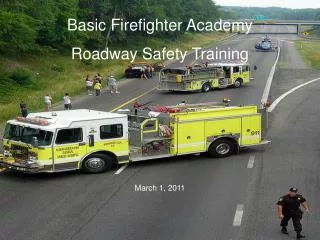
Proper Positioning of Apparatus • Safest and most advantageous spot • Must minimize exposure of rescue personnel to oncoming traffic • Position vehicles on the approach side of the accident in the same lane of traffic involved • Get between involved vehicles and oncoming traffic if possible • No obvious hazard, no vehicle should be parked any closer than 100’ of crash site
Safety Upon Arrival At Scene • 3 hazard categories must be addressed • Environmental • Weather arrival • Incident • Related to incident • Crowds, hazmat, traffic, electrical • Vehicle • Vehicles involved themselves • Fuel, battery, stability, sharp objects
Initial Rescue Activities • Sequence of activities • Arrival • Size-up • Establishment of command • Scene stabilization • Patient access • Initial emergency medical care