The Skeletal System
Explore the classification of bones within the skeletal system, focusing on the four primary types: long, short, flat, and irregular bones. Learn the anatomy of long bones, including the epiphysis, diaphysis, and periosteum, as well as the roles of compact and spongy bone. This guide also discusses bone development processes—intramembranous and endochondral—and the differences between these two methods. Enhance your understanding with visual aids like Venn diagrams to visually compare bone development types.

The Skeletal System
E N D
Presentation Transcript
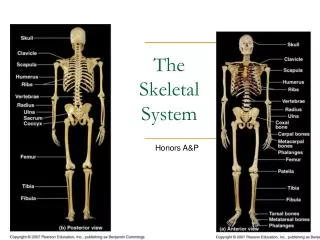
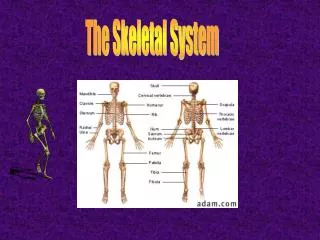
Bone Classification • Long bones: arms • Short bones: wrists • Flat bones: scapula • Irregular bones: vertebrae
Long Bones: Parts • Epiphysis: “knobby” ends of the long bones • Articular cartilage: Outside portion of the epiphysis which provides smooth glide for joints • Diaphysis: The narrow, length section of a long bone • Periosteum: outermost covering of fibrous tissue on the bone
Long Bones: Parts Cont. • Compact bone: section of the bone with no gaps which makes up the wall of the diaphysis • Spongy bone: section of the bone with thin layer of bone with gaps which makes up the epiphysis • Medullary cavity: hollow chamber in the middle of the diaphysis • Endosteum: lines the medullary cavity and houses the bone-forming cells • Marrow: connective tissue found in the gaps of bones.
Intramembranous vs. Endochondral • Bones classified by the way they develop • Most bones are endochondral • Please look at page 198 in your book and crate a Venn Diagram to highlight the major differences between intramembranous bone development and endochondralbones