Download
1 / 5
50 likes | 198 Vues
This guide explores fundamental principles of mechanical advantage and efficiency in simple machines. It covers key concepts, including work input and output calculations using formulas such as W = Fd. Through practical examples involving block and tackle systems and ramps, we calculate work input, work output, and efficiency percentages. Additionally, the mechanical advantage for levers, inclined planes, and pulleys is explained with relevant equations and methods for determining mechanical advantage based on resistance and effort forces.

E N D
Mechanical advantage, Efficiency and WO WI Simple machines
Work output, work input • W = Fd • Using a block and tackle, you supply an effort force of 250N and move the rope 3m. The load being lifted is 750N and moves a distance of 1m. What is the work input and work output? • W = Fd; 250N x 3m = 750J • W = Fd; 750N x 1m = 750J
Efficiency of a machine • Efficiency = Work Output ÷ work input x 100 • Express as a percentage (%) • A force of 1200N is needed to move a box up a ramp. The ramp is 4m long. The ramp raises the 3200N resistance (load) to a height of 1 m. What is the work output, the work input and the efficiency of the ramp? • Work input: W = Fd; 1200N x 4m = 4800J • Work output: W = Fd; 3200N x 1m = 3200J • Efficiency: 3200J ÷ 4800J x 100 = .67 x 100 = 67%
Mechanical Advantage for a lever or inclined plane • MA = Resistance force ÷ Effort force MA = R ÷ E • MA = Effort distance ÷ Resistance distance (length of ramp ÷ height of ramp) MA = ED ÷ RD • MA = Effort arm ÷ Resistance arm MA = EA ÷ RA
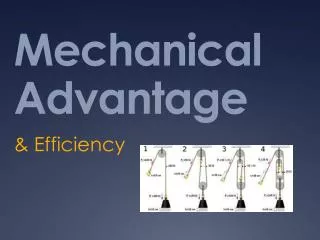
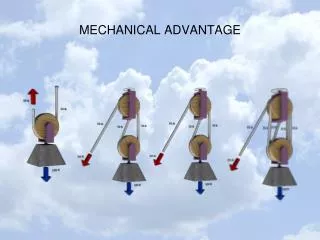
Mechanical advantage for a pulley • Count the number of strands of rope that support the load or resistance force • 1 fixed pulley – 1 • 1 moveable pulley – 2 • 2 fixed and one moveable pulley – 3 • 2 fixed and 2 moveable pulleys – 4