Download
1 / 12
120 likes | 258 Vues
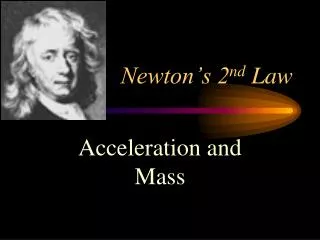
Newton's Second Law of Motion states that the acceleration of an object is directly proportional to the force acting on it and inversely proportional to its mass. This principle can be summarized as F = m × a, where F is force, m is mass, and a is acceleration. Practically, this means that applying a greater force results in greater acceleration, while increasing mass leads to decreased acceleration when the force is constant. Explore examples, practice problems, and the unit of force (Newton) to better understand this foundational concept in physics.

E N D
Newton’s 2nd Law Acceleration and Mass
Newton’s 2nd Law Force = mass x acceleration - The acceleration of an object depends on its mass and the force applied to it.
Newton’s 2nd Law Part 1 • Acceleration depends on mass (inverse relationship).
Newton’s 2nd Law Part 1 • Pushed with same force, acceleration decreases as mass increases and vice versa.
Newton’s 2nd Law Part 2 • Acceleration depends on force (direct relationship)
Newton’s 2nd Law Part 2 http://www.ic.arizona.edu/~nats101/n2.html • As force on an object increases, acceleration increases
Newton’s 2nd Law part 2 As force on an object decreases, acceleration decreases
Force= Mass x Acceleration Equation for Newton’s 2nd Law Mass = Force / Acceleration Acceleration = Force / Mass
Unit of Force • Newton (N)
Rocket Videos • Same Force but different Masses • Results in greater acceleration for the smaller rocket
Practice Problem • F=MxA • What force is necessary to accelerate a 1,000kg car at a rate of 40m/s/s? • 1,000kg x 40m/s/s= • 40,000N
Practice Problem 2 • A=F/M • What is the acceleration of a 7kg mass if a force of 42N is used to move it toward Earth? • 42N / 7kg= • 6m/s/s