Understanding Economic Organization: Types of Resource Allocation in Economies
This overview explores the three fundamental types of economic organization that allocate resources: traditional economy, command economy, and market economy. In a traditional economy, production and distribution are based on established customs and community values. Command economies, characterized by centralized planning, dictate resource allocation through government mandates, as exemplified by the Soviet Union's Gosplan. In contrast, market economies rely on individual decision-making and market dynamics, allowing resources to be allocated based on supply and demand, ultimately influencing income distribution based on ownership.

Understanding Economic Organization: Types of Resource Allocation in Economies
E N D
Presentation Transcript
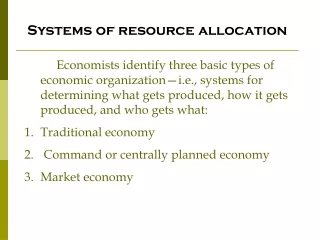
Systems of resource allocation • Economists identify three basic types of economic organization—i.e., systems for determining what gets produced, how it gets produced, and who gets what: • Traditional economy • Command or centrally planned economy • Market economy
Traditional Economy • Resources are allocated according to long-established practices. • Methods of production tend to be unchanging. • Goods and services are distributed based on community views about fairness and justice.
Command or central planning • The planning authorities decide what gets produced--resources are allocated according to planning documents issued by central planning authorities. • The “visible hand” of the planners overrides the “invisible hand” of the market. • Gosplan of the old U.S.S.R. is the classic example of a central planning agency.
The Market System • Resources are allocated though individual decision making. • The market system relies on the choices made by individuals (buyers and sellers) to allocate resources in a socially optimal way. • The economy is an agglomeration of markets, defined as “groups of buyers and sellers with the potential to trade with each other.” • Income distribution is mainly determined by the market value of resources owned (including labor).