Understanding Mitosis: Stages from Interphase to Telophase
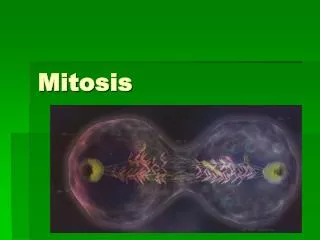
Mitosis is a crucial biological process that allows eukaryotic cells to divide and reproduce. It begins with Interphase, where the cell grows and duplicates its DNA. Prophase follows, as the chromatin condenses into visible chromosomes. During Metaphase, chromosomes align at the cell's center in preparation for separation. Anaphase triggers the separation of chromosomes, and finally, Telophase occurs where the cell membrane pinches off, resulting in two distinct daughter cells, each with its own nucleus and cellular structures.

Understanding Mitosis: Stages from Interphase to Telophase
E N D
Presentation Transcript
Mitosis Michael Deters
Interphase The increases its size and makes a copy of its DNA.
Prophase In which the chromatin condenses (it becomes shorter and fatter)into a highly ordered structure called a chromosomein which the chromatin becomes visible.
Metaphase Is a stage of mitosis in the eukaryotic cell cyclein which condensed & highly coiled chromosomes, carrying genetic information, align in the middle of the cellbefore being separated into each of the two daughter cells.
Anaphase It begins with the regulated triggering of the metaphase-to-anaphase transition. Metaphase ends with the destruction of cyclin, which is required for the function of metaphase cyclin-dependent kinases (M-Cdks).
Telophase It pinches off the separated nuclei. The cleavage of the cell becomes more accentuated, and eventually the cell splits into two separate cells complete with nuclei and their own cell apparatus.