Understanding Earth's History through Geologic Time
260 likes | 427 Vues
Learn how tree rings, ice cores, fossils, and radioactive dating provide insights into Earth's past. Discover the divisions of geologic time and major events that shaped our planet.


Understanding Earth's History through Geologic Time
E N D
Presentation Transcript
Each ring represents a year. • Width of the ring tells us how much the tree grew that year. • Thick rings mean enough water for good growth. • Helps develop weather patterns Tree Rings
Greenland and Antarctica • Snow has built up massive layers of ice • Scientists drill a hole in the ice and take out a tube of ice • This shows a vertical timeline of Earth’s past. Ice Cores
Scientists analyze the trapped air to see how the atmosphere has changed. • Dust or ash trapped show when volcanic activity. • Different levels of ice show temperature differences. Ice Cores
Fossils should be arranged in order for things to make sense • Shows the age in relation to other things. • There are many things that cannot be given exact ages. Relative Aging
The older the rocks, the further down they are. • Things found in the layers show us how old they are. • Movement of plates can disturb the layers. • Compare disturbed and undisturbed layers.
Sedimentary rock can be disturbed by igneous rock. • How? • Magma pushes up through the sedimentary rock. Igneous Rock
If the molten rock erupts, if forms a new layer. • The igneous rock is younger than the sedimentary rocks under it, but older than the sedimentary rocks above.
The actual age of something is called its absolute age. • Atoms breakdown or change into other elements. • That breakdown is called radioactivity. Radioactive Dating
The radioactivity is important because the atom will breakdown at the same rate forever. • Half-life is the amount of time it takes for half of atoms in a sample to change. • Some are fractions of a second, some are billions of years.
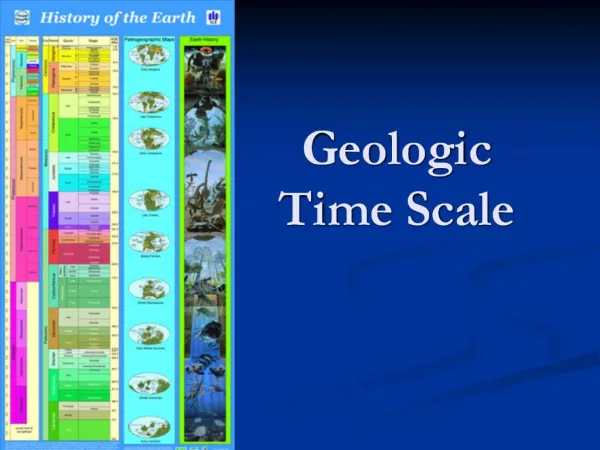
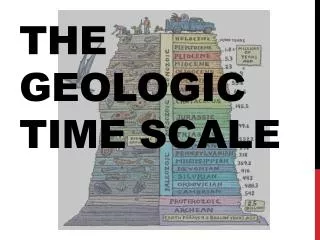
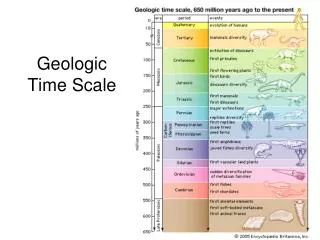
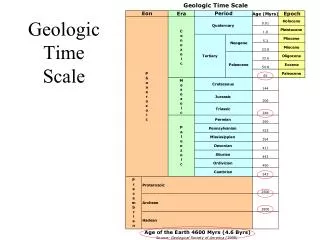
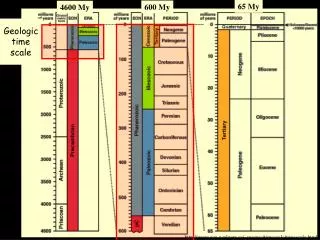
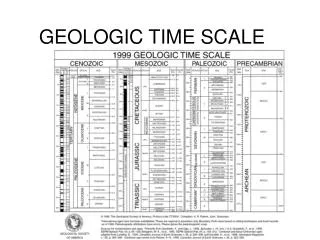
Geologic time scale divides Earth’s history into parts based on major events.
Eon • Largest unit of time • Earth’s 4.6billion year history has 4 eons. Divisions of Geologic Time
Era • Eons are divided into eras. • Most recent eon has three eras • Paleozoic • Mesozoic,and • Cenozoic
Period • Each era is divided into periods
Epoch • The periods of the Cenozoic, the most recent era are further divided into epochs
The first three Eons are called Precambrian time and make up approximately 90% of Earth’s history. • Any fossils from this time are too small to be viewed without a microscope.
The most recent eon • Began 544 mya • Divided into three eras: • Paleozoic • Mesozoic • Cenozoic Phanerozoic Eon
All life was in the ocean • Fish, the first life with a backbone developed during this time. • Towards the end of the era, life moved on to land. • Reptiles, insects and ferns were common. • A mass extinction occurred at the end of the era. Paleozoic Era
Lasts for 183 my • Best known for the dinosaurs • Mammals, birds and plants also appeared. • For some of this time, North America was covered in a sea. • Another mass extinction occurs at the end of the era. • Possible cause was a massive asteroid. Mesozoic Era
Quarternary • 2mya to the present • A series of ice ages • Mammoths, saber toothed cats, other giant mammals • Fossils of first humans found. Dated to 100,000 years ago. • Ocean levels rose and fell. Allowed humans to travel. Cenozoic Era “Age of Mammals”
Started 65 mya • Often called the “Age of Mammals” • Divided into two periods; Tertiary/Quarternary Cenozoic Era