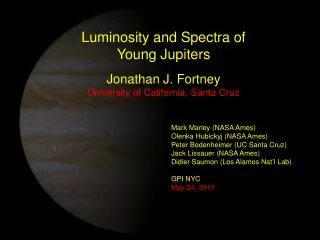
Young Jupiters are Faint
200 likes | 327 Vues
This study by Jonathan Fortney and colleagues explores the evolution of young gas giant planets using nucleated collapse models. The team discusses the uncertainties in initial conditions that affect model predictions for objects younger than a few million years. Key findings suggest that models based on "hot start" scenarios overestimate radius and underestimate gravity. The incorporation of atmospheric opacity is crucial for understanding formation times and luminosity. Using the companion of M1207 as a case, the research highlights the difficulty in assigning accurate masses to young exoplanets.


Young Jupiters are Faint
E N D
Presentation Transcript
Young Jupiters are Faint • Jonathan Fortney (NASA Ames) • Mark Marley (Ames), Olenka Hubickyj (Ames/UCSC), • Peter Bodenheimer (UCSC), Didier Saumon (LANL) Don Davis
Review evolution at young ages • Nucleated collapse models (Core accretion – Gas capture) • Alternate early evolution • Other detectability issues
“Arbitrarily Hot Start” Teff (K) log Age (Gyr) Burrows et al. 2001
Early Model Evolution • Initial conditions are uncertain • initial radii too large for smallest masses • collapse & accretion not spherical • “...assigning an age to objects younger than a few Myr is totally meaningless when the age is based on models using oversimplified initial conditions.” Baraffe et al. (2003) • When can the models be trusted? • Can initial conditions be improved?
Nucleated Collapse Model • Model for accretion of giant planets • 10 to 20 M⊕core forms first, initiates collapse of nebula • Time to gas runaway sensitively depends on atmospheric opacity • Peak accretion luminosity, created by shock, is short lived • Gives initial boundary condition for subsequent evolution Hubickyj, Bodenheimer & Lissauer (2005)
Arbitrarily hot start overestimates radius and under- estimate gravity at all masses
How long is the formation time? • Opacity of proto-atmosphere affects formation time, as does surface density of the nebula • Only Podolak (2003) has tried to calculate the opacity of the proto-atmospheres during formation • When does t = 0? • Agreement with standard cooling models is even worse if one assigns t=0 to the post-formation time Hubickyj, et al (2005)
A Potential Application: 2M1207 Companion • Companion to ~M8 brown dwarf in TW Hydrae (age ~ 8 Myr) • red J-K implies late L, Teff ~ 1250 K • Models give M = 5 ± 2 MJup Chauvin et al. (2004)
Teff (K) log Age (Gyr) Burrows et al. 1997
Similar Problem for Other Objects? AB Dor C Reiners et al. (2005) – young M star Close et al. (2005) – young M star Mohanty et al. (2004a,b) Comparisons with hi-res spectra Masses down to deuterium burning limit Zapatero Osorio et al. (2004) Dynamical masses of GJ 569 Bab brown dwarfs
SOri70 Moral • Discern mass from g, Teff indicators in spectra & colors, not luminosity at young ages (This was just done for GQ Lup b) • (Of course, this isn’t always easy…) log g = 5.5 log g = 4 from Knapp et al. (2004)
Which Bandpasses to Search? Jupiter’s M band flux has stories to tell! M band Jupiter image courtesy Glenn Orton
Nonequilibrium CO dims M band Saumon et al. 2003
Conclusions • Luminosity of young giant planets depends sensitively on initial conditions • Nucleated collapse models are cooler, dimmer, and smaller than generic ‘hot start’ evolution calculations. Differences... • persist longer than “a few million years” • are more significant at larger masses • Use of ‘hot start’ evolution may result in substantially underestimating mass of observed objects, depending on actual formation mechanism