Download
1 / 4
40 likes | 192 Vues
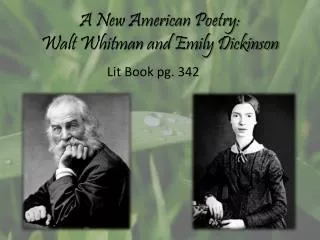
This exploration delves into the contrasting yet interconnected poetic styles of Walt Whitman and Emily Dickinson. Both poets observe humanity but do so through distinctive lenses: Whitman's free verse champions the vibrant cacophony of society, while Dickinson's introspective verse reflects her rich inner life and affinity for nature. Despite their differing approaches—Whitman's self-published "Leaves of Grass" and Dickinson's posthumously celebrated works—their poetry sheds light on themes of self-discovery, community, and the human experience. Together they redefine American poetry’s landscape.

E N D
A New American Poetry • Opposites create – only similar in need to break away from conventions • Both observers of people – but through different vantages • Whitman published “Leaves of Grass” independently – Dickinson published only 6
Comparison of their poetry • Believed documenting society and knew it would be carried into the future. • Thought his poetry was important enough to publish at his own expense. • He wrote in free verse: Cadence is the rhythm or musicality of sounds that great speakers use. Models for the modern writer; inspired generations of poets. • Her poetry came from her rich internal life and her love for nature. • Most of her poetry was published posthumously (after death). • Only 6 poems were published anonymously in her life time. • She used rhyme and meter, but created a unique poetic form with her word choice and grammar usage.
Free Verse & Slant Rhyme • Free verse • Uses multiple techniques: metaphor, alliteration, imagery, parallel structure, but never RHYME • Cadence found in free verse - flow of words that have a rhythmic rise and fall in sound, not fixed, but natural • Slant rhyme • Used to emphasize certain words • “Eye” rhyme, half rhyme, or near rhyme • today / Victory, Gate/mat, NOT scarce/lain • Hope is the thing with feathers • That perches in the soul, • And sings the tune without the words, • And never stops at all.
American Lit Themes • Innocence to Awareness/Experience: • a mental, spiritual, and physical movement (Leaves of Grass) • To Salvation/Pilgrimage: • Dickinson poems reveal her journey to know God through nature • Self-made Man: • Rags to riches story found in Whitman’s poetry, but rich in knowledge and experiences • The New Frontier: • Whitman discovered not only the land, but also who we are and what we can be through travel • Community vs. Society: • Both poets desired a movement towards community and away from society, though their ideas of community and society were slightly different. American Journey