Stability and Control Preliminary Design Review - Performance Analysis Overview
This document presents the Stability and Control Preliminary Design Review (PDR) conducted on October 24, 2000, by Christopher Peters and Team DR2. It includes detailed analysis on empennage sizing, control surface sizing, and performance metrics such as take-off, climb, turning, and endurance. The review covers key topics like center of gravity locations, static margin, trim discussions, and dynamic simulations. The findings aim to ensure optimal design choices for aircraft stability and performance, meeting stringent criteria for mission requirements.

Stability and Control Preliminary Design Review - Performance Analysis Overview
E N D
Presentation Transcript
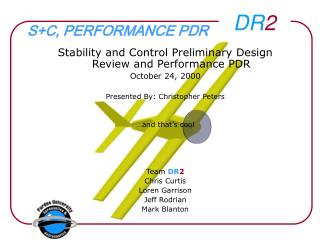
S+C, PERFORMANCE PDR Stability and Control Preliminary Design Review and Performance PDR October 24, 2000 Presented By: Christopher Peters …and that’s cool Team DR2 Chris Curtis Loren Garrison Jeff Rodrian Mark Blanton
S+C, PERFORMANCE PDR Presentation Outline: • Stability and Control • Empennage sizing • Control Surface Sizing • CG, AC and NP Locations • Trim Discussion • Static Margin • Dutch Roll Mode • Short Period Mode • Performance • Take-off and Climb • Turn • Endurance • Projected Plan
S+C, PERFORMANCE PDR Empennage Sizing: • Class I Sizing Approach • Sizing with Tail Volume Coefficients • Vvt,Vht – ROSKAM II, SEC8 • Vvt = 0.04 • Vht = 0.5 • Determined from Historical Data for small GA Aircraft, Homebuilt and Production. • VT area generally too big… • Need Class II Sizing to justify Size Selection • HT and VT analyzed using Class II Sizing
S+C, PERFORMANCE PDR Empennage Sizing: • Class II Sizing Approach • HT • Size HT using Center of Gravity (CG), Static Margin (SM), Tail Volume Coefficient (Vht) and HT-Moment Arm (lht) Information. • VT • Size VT using CG, Cnβ, Tail Volume Coefficient (Vvt), and VT-Moment Arm (lvt) Information.
S+C, PERFORMANCE PDR Empennage Sizing HT: • For Electric Model Design assume the ability to pick CG by internal arrangement of Avionics and Electronics, to fit Desired SM • Pick SM to fit Mission • Modification of X-Plot Method necessary • Analyze HT for Trimmed flight and Geometry Limitations
S+C, PERFORMANCE PDR Empennage Sizing HT: • SM, 18% is Design Goal • Possible Travel to Account for: 10%-25% • Due to Component Shift and Mission Modifications • Neutral Point Location (Xnp) Determined thru Trim-Analysis • CG Set
S+C, PERFORMANCE PDR • Empennage Sizing HT: • Neutral Point Derivation: • Calculation of lht by Sht Variation – Limited by Length of Fuselage:
S+C, PERFORMANCE PDR • Empennage Sizing HT Solution: Sht = 2.25ft2 ARht = 4 bht= 3.0 ft cht = 0.75 ft Vht = 0.5 lht = 3.171 ft
S+C, PERFORMANCE PDR Empennage Sizing VT: • Vvt Variation for Svt Calculation determined by Weathercock Criterion for ‘Manned Aircraft’: • Simultaneously Calculation of lvt by Vvt Variation – • Iteration Process, Cnβ update – Effects on Dutch Roll Mode • Weathercock: Cnβ >= 0.057 rad-1
S+C, PERFORMANCE PDR • Empennage Sizing VT Solution: Svt = 0.77ft2 ARvt = 2.5 bvt= 1.39 ft cvt = 0.56 ft Vvt = 0.024 lvt = 3.38 ft SvtHIST = 1.69ft2
S+C, PERFORMANCE PDR Control Surface Sizing : • Control Surface Sizing thru Class I Method: • Estimation based on Empirical Data • From ROSKAM II/8 and former 451 Reports: • Elevator: 40%croot – 45%ctip , Full Span • Rudder: 35% croot - 48% ctip, Full Span • Aileron: 25% cw – 60% Span • Deflection Limits: • Rudder/Elevator: +/- 10º • Flat Plate Airfoil Approximation – Separation • No Dihedral, Rudder and Aileron Control
S+C, PERFORMANCE PDR Aerodynamic Center, CG, SM: • Aerodynamic Center Wing • 23% of Cmean – For Biplanes (Raymer) • Aerodynamic Center Aircraft • As shown Before, Xnp = 1.85ft (from FS 0, - Nose of A/C) • CG • SM = 18%, CG = FS 1.68 • SM = 10%, CG = FS 1.75 • SM = 25%, CG = FS 1.61
S+C, PERFORMANCE PDR Aerodynamic Center, CG, SM: • CG Calculation, Mass Inertias • Component Shift to meet SM = 18% • Determine Mass Inertias for given CG • Ixx = 0.5 slugs-ft^2 • Iyy = 0.54 slugs-ft^2 • Izz = 0.96 slugs-ft^2
S+C, PERFORMANCE PDR Trim: Force and Moment Balance
S+C, PERFORMANCE PDR Moment Coefficient: iwu= 0 deg iwl= -2 deg iht= 0 deg
S+C, PERFORMANCE PDR Trim Conditions
S+C, PERFORMANCE PDR Trim Conditions
S+C, PERFORMANCE PDR Dutch Roll Mode: ζDR = 0.212 ωDR =2.102
S+C, PERFORMANCE PDR Short Period Mode Approximation (after DR K. Hout): ζSP = 0.57 ωSP =5.62
S+C, PERFORMANCE PDR Performance • Endurance • After propulsion PDR II • Endurance Requirement met and exceeded at Vloiter=25 ft/s • Takeoff Distance • Less than 35 ft • At Climbangle > 6deg. • Easily meeting abort mission and climb constraints
S+C, PERFORMANCE PDR Performance • Projected Work • Detailed Analysis of Performance Parameters • Take-off • Turning • Dynamic Simulation of Aircraft • Mission Analysis with finalized Parameters