High Level Motion Authoring for Articulated Figures
60 likes | 192 Vues
Explore innovative methods of animating articulated figures using a high-level motion authoring system. Our work focuses on enabling artists to intuitively command figures to perform actions like walking or waving through a timeline interface, eliminating the complexity of traditional animation methods. By leveraging Maya's powerful capabilities, we create 3D animations based on a hierarchical bone structure with streamlined commands. We detail our tools, including plug-ins like Setpose and Takeplist, that simplify the animation creation process while incorporating Maya's internal interpolation algorithms, given the complexity of scripting and APIs.


High Level Motion Authoring for Articulated Figures
E N D
Presentation Transcript
High Level Motion Authoring for Articulated Figures http://www.columbia.edu/~msw2103/cs4167/ Michael Wasserman & Michael Ilardi
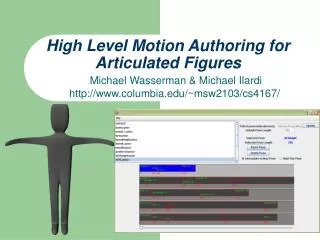
Concept • What if you could just tell your articulated figure to walk or wave its hand? • Using a timeline interface, an artist could “paint” animations onto an articulated figure. • Using Maya this could be rendered as a 3D animation for some given hierarchical bone structure.
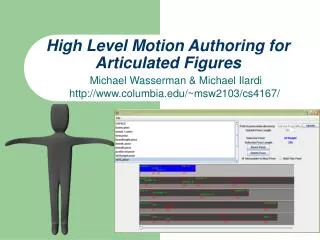
Demo • Using these simple commands: • takepose posename rootofpose • (Timeline editing) • takeplist plistname • Produce this animation: • (Play clips)
Tools • Maya – Professional level modeling and animation software • MEL – Maya’s Embedded (scripting) Language • Maya API – Application Programming Interface (C++, plug-ins) • Our tools • Skeleton and Skin – Gimbal rotations, root translations, and subd. • Setpose – A plug-in used to record information about the state of the articulated figure to a .pose file • Timeline – Graphical interface for creating .plist and .anim files from .pose and .anim files (hierarchical, open, manipulate, save, export) • Takeplist – A plug-in to apply a .plist scene to the articulated figure
Conclusion • Both of us realized that tackling the intricacies of Maya’s scripting language, API, and the plethora of data structures required to administrate an animation (and give it a graphic interface) was a much larger project than originally thought. • As such, we were compelled to use Maya’s internal interpolation algorithms, not our own. • IK vs. FK tradeoffs