The Renaissance: Rebirth of Classical Ideas and the Impact of the Bubonic Plague
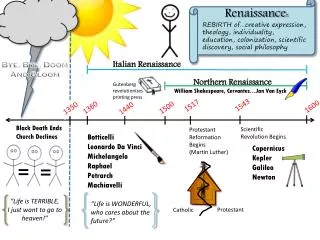
The Renaissance, meaning "rebirth," began in Italy and was fueled by the suffering and societal questioning stemming from events like the Bubonic Plague. The plague, which killed 60% of the urban population, created labor shortages that led to higher wages and a pursuit of art by affluent merchants like the Medici family. This period saw the rise of humanism, emphasizing individual potential and achievements rooted in classical ideas. As the movement spread to Northern Europe, it evolved, emphasizing religious reform and creativity amid recovering populations and wealthy patrons.

The Renaissance: Rebirth of Classical Ideas and the Impact of the Bubonic Plague
E N D
Presentation Transcript
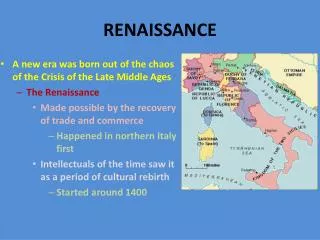
Renaissance • Birthplace – Italy • Suffering leads to need for new/classical ideas • Questioned the church on why they had to suffer • Medieval ideas blocked social advancement • Renaissance means “rebirth” Why Italy? (large cities, wealthy merchant class, large towns, urban)
Bubonic Plague • How did the Bubonic Plague affect the Renaissance movement? • Killed 60% of the population in the cities • With fewer laborers – demanded higher wages • Reduced population shrunk opportunities for business expansion • Wealthy merchants began to pursue other things like art
Medici Family • Because of the increased trade due to the Crusades, the merchant class was the wealthiest • Merchants did not inherit status – but felt they deserved it because of what they had accomplished on their own • Medici family wealthiest • Basically a dictator • Supported the arts
Classical Ideas and Humanism • They studied classical ideas: Greek and Roman • Classical ideas led to humanism • Human potential and achievement • Encouraged studies of history, literature, philosophy = humanities • Were secular – remained devout Catholics, but felt that people could enjoy life with offending God Popes and wealthy merchants became patrons
“Renaissance Man” • Was educated in many areas • Expected to create art Renaissance Women - know the classics - be charming - not seek fame - inspire art not create it
Northern Renaissance • By 1400’s the spread of the Renaissance reached Northern Europe • Merchants carried the ideas north • 100 Year’s War had ended • Population from the Bubonic Plague was recovering • Cities and wealth grew • Patrons began to sponsor artists and writers
France and England were under monarchs – unlike Italy • Rulers and wealthy merchants began to sponsor artists • France invites da Vinci to retire there Royal Courts • Played role in spread of Renaissance ideas • Every court wanted to be on the cutting edge
Renaissance Ideas of the North • Renaissance ideas mingled with northern traditions • Were more concerned with religious ideas than secular ideas of Italy • This caused a push for religious reform based on Christian values Students fleeing a French invasion of Italy carry ideas to Northern Europe
Gutenberg’s Printing Press • Presses paper against a tray full of linked movable type • Allowed hundreds of copies of the same page • Affordable for all • Spread ideas • Many books were in vernacular – so even those not classically educated could read them
Gutenberg’s Bible • Used his printing press to print the complete Bible • First full sized book printed with movable type • Bible eventually printed in vernacular • Allowed people to interpret the Bible for themselves and they became more critical of priests and their behavior • Leads to demands for religious reform