Advancements in MM5 Research at Wageningen University: Mesoscale Phenomena and Modeling Techniques
130 likes | 247 Vues
This research focuses on the MM5 model at Wageningen University. Key components include validation with detailed observations, improving physical representations, and understanding mesoscale phenomena. The studies emphasize land-surface and boundary-layer processes, deep convection, and microphysics to enhance the accuracy of weather models. Sensitivity analyses of energy budgets, soil moisture effects, and the impact of vegetation on surface temperature are central to this work. BSc/MSc education integrates these themes, guiding students in mesoscale meteorological modeling and critical interpretation of results.


Advancements in MM5 Research at Wageningen University: Mesoscale Phenomena and Modeling Techniques
E N D
Presentation Transcript
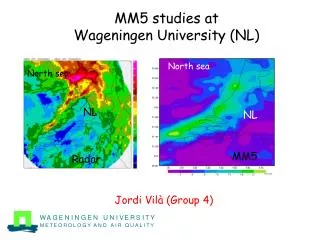
Title MM5 studies at Wageningen University (NL) North sea North sea NL NL MM5 Radar Jordi Vilà (Group 4)
MM5 research based on 4 components: Validation with detailed observations physical processes Improving physical representations Specific research studies to understand mesoscale phenomena BSc/MSc Education
Validation physical processes Land-surface schemes Planetary boundary layer schemes Deep Convection Microphysics Method: Intensive use of observations Sensitivity analysis
Energy budget Partition of the sensible heat flux (H) and latent heat flux (E) depends on the soil moisture availability Rn = H + LvE + G Rn H LvE G
Energy budget + Observations - MM5 results
Improving physical representations Surface and boundary layer processes Entrainment Interaction land-atmosphere
Are we able to improve the Nocturnal BL representation in mesoscale models? (Gert-Jan Steenveld et al., WUR) Implementation of a vegetation layer to improve representation of the surface radiative cooling Limit the turbulent mixing in stable stratifications (local scaling)
Temporal evolution of the surface temperature + CASES99 Observations Continuous Standard scheme Dotted Vegetation layer Dashed Veg. layer + local mixing Best agreement with observations after introducing vegetation lager and local turbulent mixing=> Potential impact on LLJ formation Intermittent Turbulent Radiative
Temporal evolution of the vertical profiles potential temperature + CASES99 Observations Cont. Standard scheme Dot. Vegetation layer Das. Veg.layer + local mixing Turbulent mixing decreases Radiative cooling is more effective
Research studies: Mesoscale phenomena strongly coupled with surface and boundary layer Method: Case studies (costal fronts, cloud formation and development, ...)
Development of costal fronts (September-November) (Malda et al., 2007) Frictional convergence Thermal convection Convection trigger by sea/land thermal differences (accentuated at night) Backing up of the winds due to higher roughness length
Precipitation (dependence on land zo) (24-hours accumulated) zo (original ≈ 15 cm) zo=100 cm zo= 0.01 cm North sea North sea North sea NL NL NL
Education ●MSc course (6 ECTS) Mesoscale Meteorlogical Modelling Learning emphasis on: To do research using mesoscale model Critical interpretation MM5 results ●Master thesis based on MM5 More info at: http://www.met.wau.nl/