Exploring Polarization Mechanisms in Wide-Angle Compton Scattering
260 likes | 400 Vues
This proposal outlines an experimental program to investigate the reaction mechanisms of Wide-Angle Compton Scattering (WACS). Key questions include the contributions of individual and collective partonic responses in photon interactions with quarks. The experiment aims to provide crucial data on polarization observables and refine cross-section calculations through proposed kinematics at photon energies around 4.3 GeV. With the goal of discerning the fundamental reaction mechanism, this study promises to link theoretical predictions with experimental observations in a well-established experimental framework.


Exploring Polarization Mechanisms in Wide-Angle Compton Scattering
E N D
Presentation Transcript
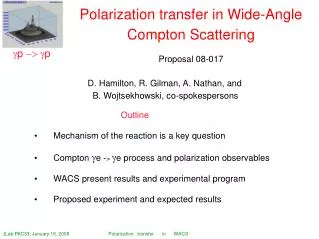
Polarization transfer in Wide-Angle Compton ScatteringProposal 08-017 D. Hamilton, R. Gilman, A. Nathan, and B. Wojtsekhowski, co-spokespersons Outline • Mechanism of the reaction is a key question • Compton e -> e process and polarization observables • WACS present results and experimental program • Proposed experiment and expected results
Mechanism of the process Two basic options for mechanism: Collective response - several partons involved in high momentum interaction with the photons Individual response - one quark absorbs incident photon and the same quark emits scattered photon
Studies of the RCS process • Regge poles - VMD - since 1960’s …, Laget • pQCD - two-gluon - Brodsky, …, Guichon&Vanderhaeghen, Brooks&Dixon, Thomson et al. • Diquark model - Guichon&Kroll, 1996 • Leading quark - Brodsky et al., 1972 • GPDs (handbag) - Radyushkin, Kroll et al. • CQM - G.Miller Main issues: • Competing mechanisms • Interplay between hard and soft processes • Threshold for onset of asymptotic regime • Role of hadron helicity flip
Compton in 1925 photo electron Directed Quanta of Scattered X-Rays Arthur Compton and Alfred Simon, PR 26, 3 (1925) recoil electron
Cross section of WACSvs pQCD calculations Cornell data JLab data Calculation by Brooks & Dixon Calculation by Thomson et al normalization problems, calculations are 3-10 times below data
WACS in GPD approach • Single-quark mechanism “handbag” diagram accounts for scattering from quark and introduces the FFs for ++,+-, .. Form factors: RV, RT, RA KN-like polarization observables quark coupling is small compare t Form factors allows to fit cross section
The plan of proposed experiment p proposed -u = 2.3 -u = 3.6 p
Result: test of reaction mechanism Proposed for E ~ 4.3 GeV for cm angles 90o and 110o ( a 70o cm data point will be obtained in E07-002)
Result: test of reaction mechanism Proposed for E ~ 4.3 GeV for cm angles 90o and 110o ( a 70o cm data point will be obtained in E07-002)
Experiment concept: similar to E99-114 Beam 80% polarized, 80 μA Ee= 4.8 , <Ēγ>~ 4.3 GeV Photon flux ~ 1013 eqv. /s; in this experiment it will be boosted by an additional factor 5 with larger calorimeter
Selection of the WACS events Magnet separates e'/γ, no veto needed, allows higher luminosity
Focal Plane Polarimeter FPP used in many Hall A experiments FOM = εAy2 ~ 0.02, so we need ≈1-2 M RCS events Calibrated with ep elastic scattering
E99-114 Results vs new plan s = 6.9 GeV2 -t = 4.0 -u = 1.13 PRL 94, 242001 PRL 98, 152001 Present proposal (KLL,LT) has photon energy 4.3 GeV, large s, -t, -u
WACS research program CS research has significant chance to discover the basic reaction mechanism CS research would be extended for cross sections up to to s = 20 GeV2 with the 12 GeV upgrade, could possibly find onset of pQCD in exclusive reactions
Proposed Kinematics Eγ= 4.3 GeV, s = 8.9 GeV2 Large -t,-u Precision data for KLL, and KLT
Beam Time Request 21 days beam on target in Hall A
Summary • Mechanism of Real Compton Scattering could be found from proposed experiment - need two data points • WACS has largely the same physics as FFs and DVCS • Experimental technique is well understood and tested • This polarization experiment belongs to 6-GeV program • Beam time request: 21 days beam on target in Hall A
Beam Time Request - by hours 21 days of beam in Hall A
Reply to TAC comments • Installation time ~ < 1 month in Hall A. • As suggested by RadCon group the photon radiator will be made from Pb, for which case rad-budget is twice lower than for the standard Cu radiator.
NLO GPD-based calculations NLO corrections to the cross section are 10-20% Corrections to polarization observables ~ 1-2% at cm=90o ~ 10-15% at 120o
GPDs and form factors of WACS GA at w
Systematic Uncertainties • By far the largest contribution to systematic uncertainty from dilution factor/background asymmetry stability. • In previous analysis, background was fitted with polynomial distribution. • In future analysis, a dedicated Monte Carlo (already developed) will be used to better understand background. • Expected improvement in systematic uncertainty by factor two or more- dKLLsyst ~ 0.01