Mapping Scholarly Debate: Evolution of Thought and Metadata Integration in Academia
This article explores the evolution of scholarly debates and their documentation through various metadata schemas. It discusses existing resources such as Bibliographica.org and assesses the need for shared metadata standards in academic discourse. It highlights the relevance of linking data, the use of vocabularies, and how researchers and students can benefit from clearer bibliographic relationships. The work aims to enhance understanding and facilitate access to scholarly outputs in the digital age, fostering collaboration among researchers and institutions.

Mapping Scholarly Debate: Evolution of Thought and Metadata Integration in Academia
E N D
Presentation Transcript
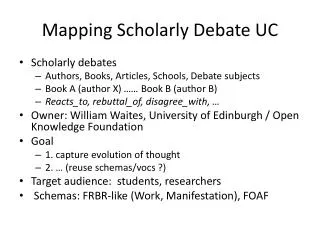
Mapping Scholarly DebateUC • Scholarly debates • Authors, Books, Articles, Schools, Debate subjects • Book A (author X) …… Book B (author B) • Reacts_to, rebuttal_of, disagree_with, … • Owner: William Waites, University of Edinburgh / Open Knowledge Foundation • Goal • 1. capture evolution of thought • 2. … (reuse schemas/vocs ?) • Target audience: students, researchers • Schemas: FRBR-like (Work, Manifestation), FOAF
Mapping Scholarly Debate UC • Existing work: Bibliographica.org, 73977 persons, 53106 manifestations and 53106 works • … but appears that no relations defined • … didn’t find the actual RDF schemas used (should be in UC definition!) • Cluster with: Digital Text Repository UC, NDNP UC, Publishing 20th Century Press Archives UC
Some observations on UCs • Some UCs document existing work (EP UC) • Others do not (MSD UC) • Many cases clear need for shared metadata schema • Not so clear where linked data comes in; reuse of other vocabularies or not? Else it’s Open Data, not Linked Open Data • Goals not very diverse; • reuse of vocabs • Linking to other datasets • Sometimes LLD principles are written down in application or goal section • Some UCs are really abstract • UC Digital Preservation • UC Component Vocabularies • UC Language Technology • UC Recollection • Isn’t UC International Registry for Authors about creating a new vocabulary?