Acids and Bases
This comprehensive guide delves into the definitions and classifications of acids and bases, covering Arrhenius, Bronsted-Lowrey, and Lewis theories. It explains pH measurement, common acids like vinegar and sulfuric acid, and the concept of normality in solutions. The guide highlights acid strength, including percent dissociation and the naming conventions for oxyacids and binary acids. Additionally, it covers key reactions, such as neutralization and titration, providing practical examples and problem-solving strategies.

Acids and Bases
E N D
Presentation Transcript
Definitions • Arrhenius • Acid is an H+ donor • Base is an OH- donor • Bronsted-Lowrey • Acid is an H+ donor • Base is an H+ receptor • Lewis • Acid is an electron pair acceptor • Base is an electron pair donor
pH • Measures acidity • = -log [H+] • 7 is neutral • Below 7 is acid, above 7 is base • Close to 7 is weaker, farther away from 7 is stronger • [H+] = inv log (-pH) • pH + pOH = 14
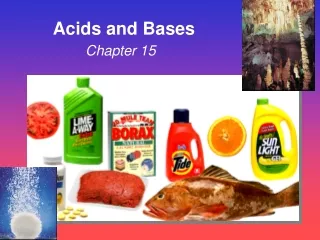
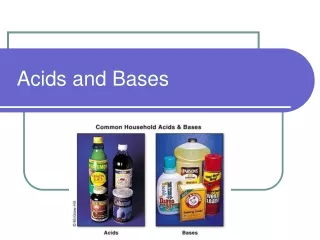
Common names • Vinegar Acetic acid • Battery acid Sulfuric acid • Muriatic acid HCl • Stomach acid HCl • Aqua regia HCl + HNO3 • Aspirin Acetylsalicylic acid
Normality • Equivalents / Liter of solution • Typically, M x subscript of H or OH = N • Need to use normality in titration equation
Acid strength • Refers to percent dissociation • Measured by Ka
Classification • Oxy acids • H + an oxygen containing polyatomic anion • Binary acids • H + a monoatomic anion • OR • H+ a non oxygenated polyatomic anion (ie, CN-)
Oxy acids • To name: • Name the associated polyatomic anion • Replace –ate with –ic acid • Replace –ite with –ous acid • To write the formula • Replace the –ic with -ate and write the polyatomic anion OR • Replace the –ous with –ite and write the polyatomic anion • Balance your charge out with hydrogen
Examples • HNO3 • H2SO4 • H2CO3 • HNO2 • H3PO4 • H2CrO4 • H2Cr2O7
Binary acids: no oxygen • To name: • Prefix is hydro • Name anion with –ic acid ending • To write the formula: • Write the H • Write the anion formula or symbol • Balance you charge with the subscripts if necessary
Examples • HCl • HF • H2S • HCN • HI
Give names or formulas • HNO3 • HCl • H2SO4 • Carbonic acid • Nitrous acid • Chromic acid • Hydrocyanic acid
Answers • HNO3 Nitric acid • HCl Hydrochloric acid • H2SO4 Sulfuric acid • Carbonic acid H2CO3 • Nitrous acid HNO2 • Chromic acid H2CrO4 • Hydrocyanic acid HCN
pOH and pH • pH + pOH always equals 14 • This is because the autoionization of water results in a H+ of 1x10⁻⁷ and an OH- of 1x10⁻⁷ • Example: if the pH = 7.5, what is the pOH?
Answer • If the pH = 7.5, what is the pOH? pH + pOH = 14 7.5 + pOH = 14 pOH = 14-7.5 pOH = 6.5
Neutralization HCl + NaOH NaCl + HOH You take the H from the acid and combine it with the OH from the base. That makes water. What’s left is called a salt.
Titration • NA X VA = NB X VB
Sample problem • How many mL of 2.0 N HCl are required to neutralize 30 mL of 3.7 N NaOH? • NA X VA = NB X VB • (2.0N)(VA) = (3.7N)(30mL) • Divide both sides by 2.0N • VA = 55.5mL