
SlideServe
Menu
Préférences
© SlideServe · v2026

Understanding Difficult Changes: Lessons on Adjustment and Language Skills

uma-weber avatar
152 diapositives · 1.7K Views · Nov 07, 2014

In this engaging session, we explore the complexities of adapting to change and how it affects our lives. We will delve into the concept of adjustment, using examples like moving to a new school or encountering unexpected situations. Additionally, learn about diphthongs, particularly the sounds of "oi" and "oy," as we work on vocabulary and comprehension through storytelling. By examining themes and plots, summarizing stories, and incorporating adverbs that indicate time and place, students will enhance their linguistic skills while grasping the essence of adaptation.
Understanding Difficult Changes: Lessons on Adjustment and Language Skills - slide 1
01 / 152Understanding Difficult Changes: Lessons on Adjustment and Language Skills
1 / 17

Télécharger la présentation

Understanding Difficult Changes: Lessons on Adjustment and Language Skills
Une image / un lien ci-dessous est fourni (tel quel) pour télécharger la présentation

Politique de téléchargement : le contenu du site vous est fourni TEL QUEL pour votre information et votre usage personnel ; il ne peut être vendu, concédé sous licence ni partagé sur d’autres sites sans l’accord de son auteur.Le contenu vous est fourni TEL QUEL, pour votre information et votre usage personnel uniquement. Téléchargez la présentation en cliquant sur ce lien. Lors du téléchargement, si vous ne parvenez pas à télécharger une présentation, l’éditeur a peut-être supprimé le fichier de son serveur.Pendant le téléchargement, si vous ne parvenez pas à obtenir une présentation, le fichier a peut-être été supprimé par l’éditeur.

F I N

Plus de contenu associé

Transcription de la présentation
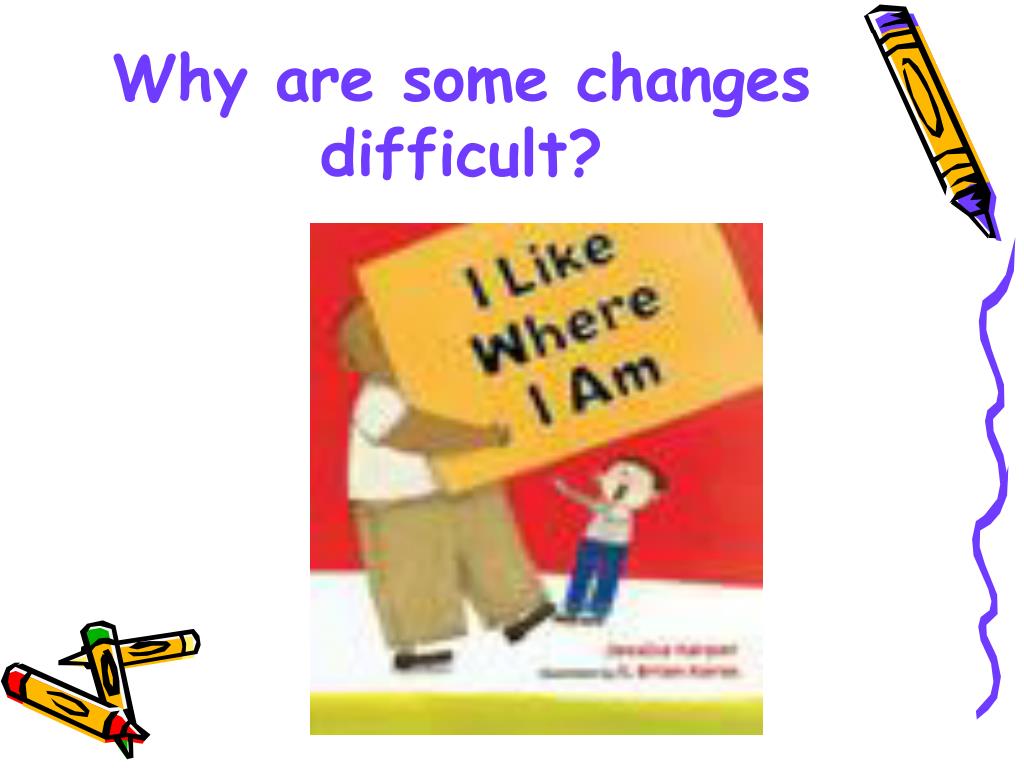
  1. Why are some changes difficult?

  2. Small Group Timer

  3. Online Games

  4. I Like Where I Am

  5. I Like Where I Am

  6. I Like Where I Am

  7. I Like Where I Am

  8. Big Question:Why are some changes difficult? • Monday • Tuesday • Wednesday • Thursday • Friday

  9. I Like Where I AmMonday

  10. I Like Where I AmMonday

  11. Today we will learn about: • Amazing Words • Dipthongs: oi, oy • Plot and Theme • Summarize • Adverbs that Tell When and Where

  12. adjust • ad – just • When you get used to a new situation, you adjust to it. • When you change or move something to make it fit or make it better, you adjust it. • The children will soon adjust to their new school. • We’ll have to adjust to the snowy weather. • Please adjust the position of the TV so we can see it.

  13. landmark • land - mark • A landmark can be any natural or human-made feature such as a building, a statue, a bridge, or a tree that identifies a location and can serve as a guide for directions. • The Great Salt Lake is a landmark in Utah. • Fisherman’s Wharf is a landmark in San Francisco. • The Empire State Building is a New York City landmark. (next word)

  14. Great Salt Lake Utah

  15. Fisherman’s Wharf

  16. Empire State Building

  17. unexpected • un – ex – pect - ed • Something that comes as a surprise or something you do not think will happen is unexpected. • The rainstorm was unexpected. • We had unexpected company yesterday. • The surprise party was unexpected.

  18. Click to listen to a song about moving to a new place.

  19. Dipthongs: oi, oy • south - cow • What do you know about reading these words? • The vowels ou and ow can stand for the sound /ou/. • Today we will study vowels oi and oy and the sound they can stand for.

  20. oil • The letters oi and oy stand for the dipthong /oi/. In a dipthong, each vowel contributes to the sound heard. • boil • coin • join • choice • noise • spoil • boy • joy • enjoy • royal • cowboy

  21. Dipthongs: oi, oy • oil • coil • The letters oi stand for the sound /oi/ in oil and coil. • boy • The letters oy stand for the sound /oi/ in boy.

  22. point loyal foil joy moist destroy broil spoil toy hoist voyage joint voice enjoy Dipthongs: oi, oy

  23. Making Words a, e, i, o j, n, p, t, y

  24. soil oyster spoil coin soy cloud boil employ scout join annoy loyal choice royal mouse Dipthongs: oi, oy

  25. I Like Where I Am

  26. Word Family Word – guess(online dictionary)

  27. Word Family Word – guess bless chess mess dress BessTruman

  28. Word Family Word – hand(online dictionary)

  29. Word Family Word – hand brand band land gland sand Grand Canyon stand grand strand

  30. Theme and Plot & Summarize • Good readers pay attention to what happens in the beginning, middle, and end of a story. • They also think about the “Big idea” behind the story as they read

  31. Theme and Plot & Summarize • Theme is the “big idea” a story is about. • Plot is what happens in the beginning, middle, and end of a story. • A summary is a short retelling of a story. • We can summarize what happens at the beginning, middle, and end of a story to help understand and remember what we read.

  32. Daily Fix-It i wipd my hands on the cloh I wiped my hands on the cloth. the childrin yelled with joy. The children yelled with joy.

  33. Adverbs that Tell When and Where • Adverbs tell more about a verb. • Some adverbs show when or where. • School begins tomorrow. • Tomorrow tell when. • I will be a a new student there. • There tells where.

  34. Adverbs that Tell When and Where • I packed my books yesterday.

  35. Adverbs that Tell When and Where • I packed my books yesterday. (when)

  36. Adverbs that Tell When and Where • I packed my books yesterday. (when) • Now I am packing my toys.

  37. Adverbs that Tell When and Where • I packed my books yesterday. (when) • Now I am packing my toys. (when)

  38. Adverbs that Tell When and Where • I packed my books yesterday. (when) • Now I am packing my toys. (when) • The movers carry boxes downstairs.

  39. Adverbs that Tell When and Where • I packed my books yesterday. (when) • Now I am packing my toys. (when) • The movers carry boxes downstairs. (where)

  40. Adverbs that Tell When and Where • I packed my books yesterday. (when) • Now I am packing my toys. (when) • The movers carry boxes downstairs. (where) • The moving van is parked outside.

  41. Adverbs that Tell When and Where • I packed my books yesterday. (when) • Now I am packing my toys. (when) • The movers carry boxes downstairs. (where) • The moving van is parked outside. (where)

  42. Adverbs that Tell When and Where • I packed my books yesterday. (when) • Now I am packing my toys. (when) • The movers carry boxes downstairs. (where) • The moving van is parked outside. (where) • Soon we will go to a new house.

  43. Adverbs that Tell When and Where • I packed my books yesterday. (when) • Now I am packing my toys. (when) • The movers carry boxes downstairs. (where) • The moving van is parked outside. (where) • Soon we will go to a new house. (when)

  44. Wrap Up Your Day! • Vowel dipthong oi, oy • Plot and Theme • Let’s Talk About It • Tomorrow we will read about a boy who has to move.

  45. I Like Where I AmMonday

  46. I Like Where I AmTuesday

  47. I Like Where I AmTuesday

  48. Today we will learn about: • Amazing Words • Dipthongs: oi, oy • Vocabulary Words • High-Frequency Words • Multiple-Meaning Words • Context Clues • Adverbs that Tell When and Where