Dendrochronological Reconstruction Dates Relative sequence Absolute dates
Dendrochronological Reconstruction Dates Relative sequence Absolute dates Errors in archeological interpretation Behavior Construction habits Environment Climate in the past. Dendrochronology Dating Does date of wood sample = construction date?. Archeological Interpretation of Dates.

Dendrochronological Reconstruction Dates Relative sequence Absolute dates
E N D
Presentation Transcript
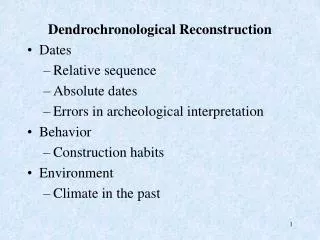
Dendrochronological Reconstruction • Dates • Relative sequence • Absolute dates • Errors in archeological interpretation • Behavior • Construction habits • Environment • Climate in the past
Dendrochronology Dating • Does date of wood sample = construction date?
Archeological Interpretation of Dates • Outer date predates construction event • Collected dead tree • Collected a bunch of trees, stockpiled • Reuse a beam from old house • 14th century log used in 1929, Oraibi • Large sites versus distinct sites • Outer date postdates construction event • New log put in during repair • Problem or solution? • Could date repair sequences
Date Clustering Saves the Day • Given lots of dates, the date of construction event will be the best cluster of dates • Most frequent date
Date Clusters • Skewed beginning: slow development of site • Steep ending: fast abandonment • Early dates may be stockpiling, re-use • Late dates may be repair beams • Requires a lot of dates, replication
Cutting Date or Not? • Outermost ring was when tree died • Evidence of cutting date: • Bark, best but not common • Complete outer ring • Beetle galleries • Dark patina veneer
Non-cutting Dates • Some number of outer rings lost • Erosion • Shaping • Burning • What to do? • Estimate # of outer rings • Admit non-cutting and leave it • Rely on clustering
Behavioral Characteristics • Type of cutting devices • Fire • Stone axes • Metal axes • Repair schedules • Stockpiling, cooperation
SW Archeology Sequence • Chaco Anasazi: abandoned by 1130-1150 • Start of a long period of drought
SW Archeology Sequence • Mesa Verde Anasazi: abandoned by 1280s • In period known as Great Drought
SW Archeology Sequence • Kayenta Anasazi: Betatakin, Keet Seel begun by 1250, abandoned by 1300 • Perhaps affected by arroyo formation