Development of IBL Package Insertion/Extraction Mechanism with Z-Stopper Design
This document outlines the design and testing process of a kinematic scheme for the Insertion/Extraction of the IBL package inside IST, highlighting the functionality and constraints of the Z-stopper mechanism. It details the use of cables for signal transmission and cooling, along with the integration of positioning forks and pins. The objective is to ensure the package can be securely engaged and disengaged within limited space. The document includes steps for prototype fabrication using titanium, testing for insertion/extraction forces, and validation of design integrity at CERN.

Development of IBL Package Insertion/Extraction Mechanism with Z-Stopper Design
E N D
Presentation Transcript
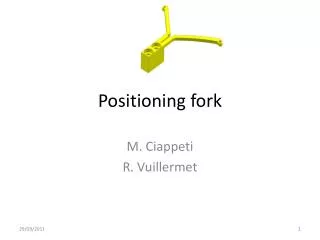
Positioning fork M. Ciappeti R. Vuillermet
IBL package kinematic scheme with services Side A IP Signal, clock Cables and cooling pipe sliding / ring HV, LV, DCS Pulling cables for insertion/extraction of the IBL Package inside IST Cooling pipes Z-stopper mechanism ID end Plate PP0 board support Sealing ring with soft interface Flex connectors PP1 Cooling pipe Fitting Cables connectors PP0 Cooling pipe bushing Beam Pipe supports same interface as current beam pipe
Beam pipe + IST Side C See next slide Side A
Beam pipe detail I.P. See next slide Side C Side A Positioning fork
Positioning fork + pin + IST IST IST pin Side C Side A Positioning fork
Positioning fork + pin IST pin Side C Side A Positioning fork
Positioning fork Side C Side A Positioning fork
Positioning fork See next slide Side C Side A Positioning fork
Positioning fork Side C Side A
Purpose of the Z stopper • Function of the Z stropper • Position along Z the IBL package respect to the IST • Guaranty that once engaged, the package can not extract • But is shall allow disengagement for the extraction process • Orientate angularly the package • Constrain in the design • Limited space to position this Z stopper • Made out of material • with low X/Xo • Can withstand activation of the area • With high enough elasticity
IBL package characteristics • IBL package weight : • about 20kg (to be re-evaluated) • Friction coefficient between IBL package and IST : • to be measured (this operation can be done at cern as we have IST with some peek interfaces
Work to be done • Step 1 • Fabricate a prototype out of a titanium plate (1.5mm) • Fabricate a test bench to measure insertion/extraction force • Test : • Measure the insertion/extraction force • Evaluate if the extraction with cables are helpful • Loop on the design to modify geometrical parameters • Step 2 • Fabricate a second prototype out of a titanium plate • Test : • Measure the insertion/extraction force • Loop on the design to modify geometrical parameters • Step n • Make a prototype out of a titanium block • Test : • Measure the insertion/extraction force • Validate the design • Install this block on the integration mock-up at CERN • Validate integration • Validate the positioning precision • Validate the insertion/extraction force