Investigation of Ionospheric Photoelectrons and Their Role in Planetary Magnetospheres
170 likes | 294 Vues
In this study, we explore the distribution of magnetosheath electron populations and their correlations with spacecraft locations. Our findings reveal wider flat-top distributions near the shock, linked to cross-shock potentials. We analyze the potentials for the VEX mission using photoelectrons from the spacecraft and ionosphere, emphasizing the role of photoionization in producing electrons within the day-side ionospheres of Venus, Mars, and Titan. Our results demonstrate that ionospheric photoelectrons serve as key tracers of magnetic connections and may influence electric fields responsible for atmospheric escape processes.


Investigation of Ionospheric Photoelectrons and Their Role in Planetary Magnetospheres
E N D
Presentation Transcript
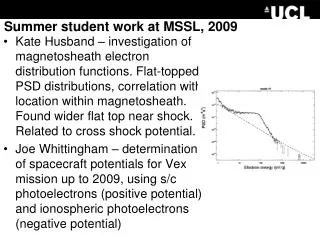
Summer student work at MSSL, 2009 • Kate Husband – investigation of magnetosheath electron distribution functions. Flat-topped PSD distributions, correlation with location within magnetosheath. Found wider flat top near shock. Related to cross shock potential. • Joe Whittingham – determination of spacecraft potentials for Vex mission up to 2009, using s/c photoelectrons (positive potential) and ionospheric photoelectrons (negative potential)
Sharon Tsang • Working on photoelectrons in tail • Paper to be resubmitted very soon (JGR-planets) • Some progress on statistical study (update at AGU)
Comparison of the ionospheres of Venus, Mars, and Titan: ionospheric photoelectrons A.J.Coates1, S.M.E.Tsang1, A. Wellbrock1, R.A.Frahm2, J.D.Winningham2, S.Barabash3, R.Lundin3, D.T.Young2, F.Crary2, Mullard Space Science Laboratory, UCL, UK Southwest Research Institite, Texas, USA IRF-Kiruna, Swedenand the CAPS and ASPERA-3 and 4 teams
Photoionisation major source on day side of planetary ionospheres – produces photoelectrons • Solar spectrum gives energies – expect electron peaks at 21-24, 27 eV • Many measurements of photoelectrons in Earth ionosphere giving detailed spectra (e.g. Lee et al 1980), other models • A ‘fingerprint’ for day side ionosphere Mantas and Hansen, 1979
CAPS, ASPERA-ELS can measure ionospheric photoelectron spectrum at Titan, Mars, Venus
Earth: ionospheric photoelectrons reach magnetosphere Fluxes seen for SZA < 97 in the ionosphere at foot of modelled Earth magnetic field Ionospheric photoelectrons in Earth’s magnetosphere up to 6.6 Re (Coates et al, 1985) • Magnetic connection from sunlit ionosphere to spacecraft • Provides non-thermal escape mechanism – electric field set up (polar wind)
Mars Express – photoelectrons in tail Frahm et al, Icarus 06, Space Science Reviews 2007 Estimate for Mars photoelectron escape 3.14x10²³ s-1 (Frahm et al Icarus in press 2009) – preliminary - photoelectron drawn escape contributes?
Liemohn et al (2006, Icarus, Space Sci Rev) modelled photoelectron paths
First observation in Venus ionosphere by VEX ASPERA-4 ELS • From O rather than CO2 Venus: solar wind interaction – 18 May 06 From Coates et al, PSS 2008
D C C D Venus – ionospheric photoelectrons seen in tail as well as day side (Tsang et al, 2009, submitted)
Titan - Ionospheric electrons in the tail: T9 encounter • Interval 1 – evidence of ionospheric plasma escape & connection to sunlit ionosphere; heavy ions • Interval 2 – mixed ionospheric and magnetospheric plasma; light ions • Role of ambipolar electric field in escape – similar to Earth’s polar wind – and lower mass from higher altitude • Coates et al, 2007b, Coates 2009, Coates et al 2009 Ionospheric photoelectrons
Titan - T15: ELS spectrogram 2 Jul 2006 8:15 UT – 10:15 UT In shadow CA photoelectrons • Photoelectrons at altitudes up to 5760km (2.2RT) • Wellbrock et al 2009
Titan - T15 modelling results Spacecraft trajectory photoelectron region Equatorial plane Titan B field lines connected to photoelectron region Corotation flow Dayside ionosphere • Sillanpää et al hybrid model results indicate magnetic connections to the dayside ionosphere. • Only B field lines connected to observed photoelectron region (pink line) are shown. • The field lines connect to the sunlit ionosphere near the south pole
Conclusions on ionospheric photoelectrons (IPE) • IPE are seen clearly in the dayside ionospheres with suitable instrumentation • The energy spectrum of IPE is distinctive, acting as a ‘fingerprint’ for ionisation processes • IPE can, at times, be seen at large distances from those ionospheres, e.g. in Earth’s magnetosphere, and in the tails of Mars, Venus and Titan • IPE are a sensitive diagnostic ‘tracer’ of a magnetic connection to the production location, namely the dayside ionospheres • IPE may play a role in setting up an electric field which would enhance ionospheric escape See Coates et al., PSS submitted, 2009 for further details
Conclusions • Photolectrons are a tracer of magnetic connection to ionosphere • Similar process at all objects with ambipolar electric field enhancing outflow