
Tides
E N D
Presentation Transcript
Tides By: Katie Cardwell May 2005
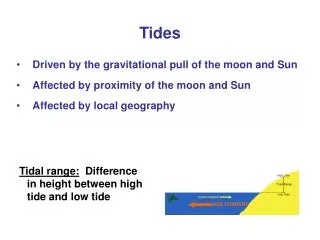
General Info • Tides are the periodic rise and fall of seawater • These are caused by variations in gravitational attraction between the Earth, the moon and the sun
More Info • There are two tidal bulges and two low points each cycle • One bulge is found on the closest point towards the moon • The other is found on the opposite point of the earth
Timing • The timing of tidal events is related to the earth’s rotation and the revolution of the moon around the earth • One revolution takes about 27 days and adds about 50 minutes to the tide cycle
Spring Tides • Spring tides are very strong tides (they have nothing to do with the season spring) • These occur when the earth, the sun, and the moon are in a line
More Spring Tides • The gravitational forces of the moon and the sun both have influence on tides • Spring tides occur during the full moon and the new moon
Proxigean Spring tides • These tides are rare and unusually high • This occurs when the moon is unusually close to the earth and is in the new moon phase • This occurs at most once every 1.5 years
Neap Tides • These tides are very weak tides • They occur when the gravitational forces of the moon and the sun are perpendicular to one another (with the earth)
Diurnal Tides • In some areas tides have one high and one low water per tidal day • These are called diurnal tides
Mixed Tides • This is the most common type of tide • In these tides the high bulges are sometimes higher as well as lower, the same applies for low tides
About Me! My Name is Katie Cardwell and I am 12 years old. I like swimming, dance, volleyball, and gymnastics. I love fast food, Italian, and desserts.
Bibliography http://www.ndbc.nobc.noaa.gov/educate/tides.shtml. May 2005. http://www.physicalgeography.net/fundamentals/8r.html. May 2005. http://www.enchantedlearning.com/subjects/ocean/Tides.shtml. May 2005. UXL Encyclopedia of Science. May 2005.