SlideServe
Menu
Préférences
© SlideServe · v2026

Atoms Molecules Elements Compounds

urian avatar
23 diapositives · 7.1K Views · Aug 04, 2014

Atoms Molecules Elements Compounds. Atom. The smallest particle that can still be identified as the matter it came from. Atoms cannot be created or destroyed. Consists of Protons (+), Electrons (-), and Neutrons (N). Video Clips: http:// www.youtube.com/watch?v=R1RMV5qhwyE
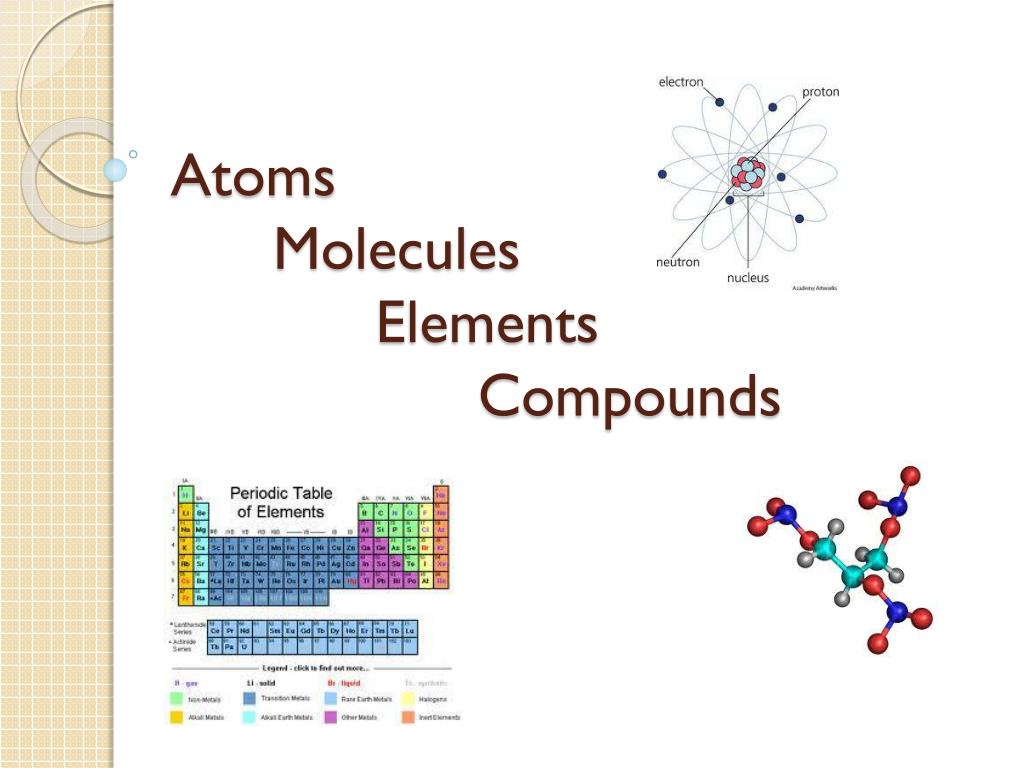
Atoms 	Molecules 		Elements 			Compounds - slide 1
01 / 23Atoms Molecules Elements Compounds
1 / 17

Télécharger la présentation

Atoms Molecules Elements Compounds
Une image / un lien ci-dessous est fourni (tel quel) pour télécharger la présentation

Politique de téléchargement : le contenu du site vous est fourni TEL QUEL pour votre information et votre usage personnel ; il ne peut être vendu, concédé sous licence ni partagé sur d’autres sites sans l’accord de son auteur.Le contenu vous est fourni TEL QUEL, pour votre information et votre usage personnel uniquement. Téléchargez la présentation en cliquant sur ce lien. Lors du téléchargement, si vous ne parvenez pas à télécharger une présentation, l’éditeur a peut-être supprimé le fichier de son serveur.Pendant le téléchargement, si vous ne parvenez pas à obtenir une présentation, le fichier a peut-être été supprimé par l’éditeur.

F I N

Plus de contenu associé

Transcription de la présentation
  1. Atoms Molecules Elements Compounds

  2. Atom • The smallest particle that can still be identified as the matter it came from. • Atoms cannot be created or destroyed. • Consists of Protons (+), Electrons (-), and Neutrons (N). • Video Clips: http://www.youtube.com/watch?v=R1RMV5qhwyE • http://www.youtube.com/watch?v=yQP4UJhNn0I

  3. Atomic Structure

  4. Atoms consist of three subatomic particles: • electrons • electrons are negatively charged particles • protons • protons are positively charged particles • neutrons • neutrons have no charge

  5. Electrons of an atom: • Small negatively charged particle • Orbit, circle, around the nucleus • Have no mass. • Number of electrons = number of protons

  6. Protons of an atom: • small, positively charged particles • reside in the nucleus • along with the neutron, make up most of the mass of the atom • the number of protons is what defines the type of a particular atom. • number of protons = number of electrons

  7. Neutrons of an atom: • small particles with no charge • reside in the nucleus • along with the proton, make up most of the mass of the atom

  8. Nucleus of an atom: • The dense area in the center of an atom. • Inside the nucleus of every atom are smaller particles called protons, and neutrons. Nucleus

  9. Element • Matter that is made of only one kind of atom is an element. • Cannot be broken down into a simpler type of matter by either physical or chemical means • Carbon, hydrogen, and oxygen are all elements. • Song: http://www.sciencekids.co.nz/videos/chemistry/elementsong.html

  10. Each element has a name and symbol:

  11. How are they arranged in the periodic table? • Elements are arranged in order of their atomic number. • The atomic number is the number of protons in the nucleus. Chemistry Rap: • http://www.youtube.com/watch?v=Apr7MdbHGQo The New Periodic Table Song: • http://www.youtube.com/watch?v=zUDDiWtFtEM

  12. Molecule • A molecule consists of two or more atoms of the same element, or different elements, that are chemically bound together. • In the animation above, two nitrogen atoms (N + N = N2) make one Nitrogen molecule . • Video:

  13. Example of Molecules

  14. More Examples

  15. Some molecules are more complex: A protein molecule: Some fat molecules: cholesterol

  16. Molecules can be represented many ways: CH4 H2O Chemical Formula: H H Structural Formula: O Ball and Stick Model: Space Filling Model:

  17. Compound • Atoms of two or more different elements bonded together. • In the animation above, water (H20) is a compound made of Hydrogen and Oxygen.

  18. Video The relationship between atoms, elements, molecules and compounds. • http://www.youtube.com/watch?v=cV4jJZCIMPo

  19. Examples:

  20. Four different molecules:Which are compounds?

  21. What are each of these?Atom, Element,Molecule,orCompound

  22. Practice with Vocabulary:

  23. Chemical Formula # of elements # of atoms total # of Carbon atoms Chemical Formulas show how many atoms of each element are in one molecule: O2 1 2 0 H2O 2 3 0 C3H8O 3 12 3 C6H12O4Cl 4 23 6