Download
1 / 29
290 likes | 423 Vues
This paper explores innovative methods for predicting the length of stay (dwell time) of users at WiFi hotspots by leveraging machine learning and behavior patterns. As mobile devices increasingly bridge the gap between networks and human interactions, understanding user behavior becomes essential. We propose an adaptive system that utilizes contextual awareness and continuous learning to enhance network management and marketing strategies. Our findings suggest improved service differentiation and resource optimization by accommodating varying user dwell times based on behavioral predictions.

E N D
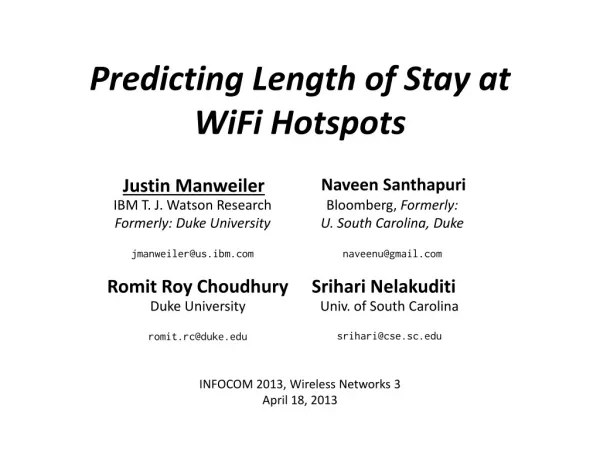
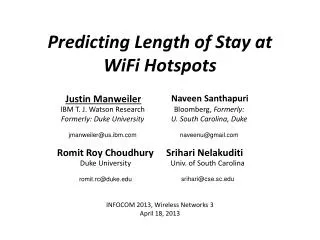
Predicting Length of Stay at WiFi Hotspots Naveen Santhapuri IBM T. J. Watson Research Formerly: Duke University jmanweiler@us.ibm.com Bloomberg, Formerly: U. South Carolina, Duke naveenu@gmail.com Justin Manweiler Romit Roy Choudhury SrihariNelakuditi Duke University romit.rc@duke.edu Univ. of South Carolina srihari@cse.sc.edu INFOCOM 2013, Wireless Networks 3 April 18, 2013
Mobile Devices are a pervasive link between networks and humans
Human Behavior is not random, predictable through pattern recognition
Behavior-aware Networking Device Sensing + Context Awareness + Network Adaptation
? ? ? ?
Matchmaking mobile multiplayer games Content Prefetching Targeted, Timely Marketing A first attempt… Length-of-stay (dwell time) prediction
A 50/50 allocation Is normally fair.. Bandwidth Customer depart… Carry-over to 3G/4G … but unfair here, short-dwelldevices leave earlier Bandwidth By prioritizing short-dwell, can equalize service. Bandwidth Time Time Time
Lots of other applications… 10€ off 100€! (stay and browse) 50% off Espresso (on your way to work)
Network Management BytesToGo traffic shaping ToGo dwell prediction Context Awareness
Large dwell variation in a real café (opportunity to provide differentiated service)
Still large performance advantage at hotspots
Behavioral patterns emerge … …but, weak signal/noise
Simplifying Insight 1 Don’t predict absolutelength of stay, predict logarithmic length of stay class • E.g., at our campus McDonald’s: • (1-2) walking past the restaurant • (2-3) buying food to-go • (4) eating-in • (4-5) studying in the dining area
Simplifying Insight 2 Don’t build a generic classifier, build a system for learning on-the-fly Ground truth learned as devices associate/disassociate from WiFi
Meta-predictor selects best feature-predictors Sequence Predictorlearns how the Meta-predictor guesses with time ToGo learns how well a sequence of sensor classifications correlates to the dwell classification
Comparative Schemes “Naïve” predict based on current dwell duration Hindsight NoFeedback (RSSI only) Basic Basic+CompassBasic+Compass+Light How much sensing is enough?
ToGo/BytesToGoProtype • Nexus One phones (client devices) • Custom Android app to report sensor readings • Linux laptop (AP) • hostapd: provide standard 802.11n AP services • Click Modular Router: record RSSI, receive sensor data • libsvm: C++ library used for realtime SVM training/prediction
“Real” users, good results … but bias from experimental process?
Observing/Replaying Human Mobility (capturing mobility without impacting it) 8:14pm 8:10pm 8:13pm 8:12pm 8:00pm
More Feedback = Faster Convergence (not shown) more users = greater precision
Live Experiment Customer arrivals/departures Performance boost for short-dwell Minimal impact for long-dwell
ToGo finds ~2/3 of available 3G/4G carryover reduction
Greedy users faking sensor readings? RSSI alone is a strong predictor … possible to sanity-check against other sensory inputs Energy overheads? Saving 3G/LTE can make up battery life; longer-dwell clients can reduce/eliminate sensor reports Multi-AP Hotspots? Even better … leverage EWLAN to apply machine learning at a central controller, improve accuracy What if user delays turning on phone? Location at which the phone is turned on is likely itself a strong discriminating feature for a quick prediction
Conclusion • Human behavior is far from random, inferable • Behavior awareness can enhance network systems • BytesToGo is initial attempts towards behavior-aware networking • Sensing • Automatic ML training at WiFi APs • Predict length of stay • Auto-optimize network based on behavior prediction
Justin Manweiler Research Staff Member Thomas J. Watson Research Center jmanweiler@us.ibm.com SyNRG Research Group @ Duke synrg.ee.duke.edu Thank you Quick plug… Come visit IBM Watson (talk, intern, fellowships, etc.)