SlideServe
Menu
Préférences
© SlideServe · v2026

Addressing Achievement Gaps in Pennsylvania's Education System

usoa avatar
30 diapositives · 438 Views · Aug 09, 2014

Pennsylvania faces significant achievement gaps among different student groups, including disparities influenced by poverty, race, and disabilities. Data shows alarming rates, with African American and Latino students often trailing behind their White peers in academic performance. The state has initiated strategies to close these gaps by focusing on tailored support and proven practices to improve outcomes. Programs like PAGE 1 Schools aim to provide resources and leadership to foster success for all students in reading and math, ultimately preparing them for higher education and the workforce.
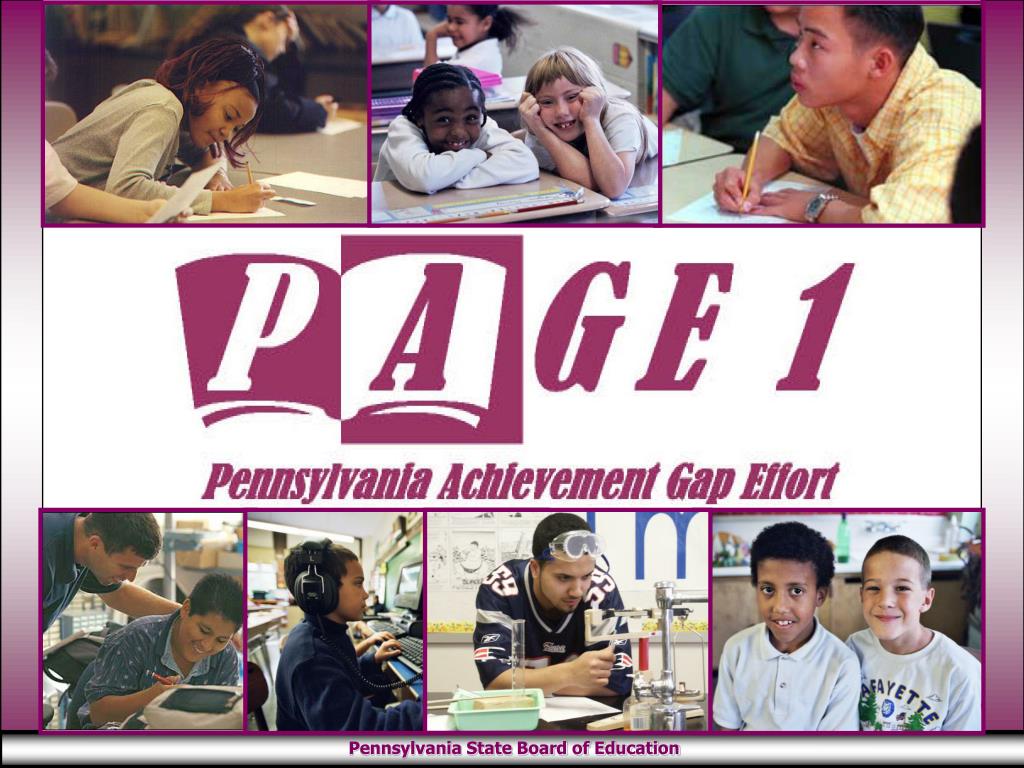
Addressing Achievement Gaps in Pennsylvania's Education System - slide 1
01 / 30Addressing Achievement Gaps in Pennsylvania's Education System
1 / 17

Télécharger la présentation

Addressing Achievement Gaps in Pennsylvania's Education System
Une image / un lien ci-dessous est fourni (tel quel) pour télécharger la présentation

Politique de téléchargement : le contenu du site vous est fourni TEL QUEL pour votre information et votre usage personnel ; il ne peut être vendu, concédé sous licence ni partagé sur d’autres sites sans l’accord de son auteur.Le contenu vous est fourni TEL QUEL, pour votre information et votre usage personnel uniquement. Téléchargez la présentation en cliquant sur ce lien. Lors du téléchargement, si vous ne parvenez pas à télécharger une présentation, l’éditeur a peut-être supprimé le fichier de son serveur.Pendant le téléchargement, si vous ne parvenez pas à obtenir une présentation, le fichier a peut-être été supprimé par l’éditeur.

F I N

Plus de contenu associé

Transcription de la présentation
  1. Pennsylvania State Board of Education

  2. The Facts An achievement gap exists when groups of students with relatively equal ability fail to achieve at the same levels in school – in fact, one group often far exceeds the achievement level of the other.

  3. The Facts A Few Common Gaps Are the Gaps Between: • Students above and students below the poverty line • White, African-American and Latino students • Students with Limited English Language Proficiency and English proficient students • Students with and students without disabilities

  4. The Facts Pennsylvania has some of the largest achievement gaps in the country.

  5. Black-White GapNAEP Grade 4 Reading Source: EdWatch Online, http://www.edtrust.org

  6. Poor-Non Poor GapNAEP Grade 4 Reading Source: EdWatch Online, http://www.edtrust.org

  7. 2004 PSSA Grade 11 Reading Source: Pennsylvania Department of Education, http://www.pde.state.pa.us

  8. 2004 PSSA Grade 11 Math Source: Pennsylvania Department of Education, http://www.pde.state.pa.us

  9. 2004 PSSA Grade 11 Readingby Race/Ethnicity Source: Pennsylvania Department of Education, http://www.pde.state.pa.us

  10. 2004 PSSA Grade 11 Mathby Race/Ethnicity Source: Pennsylvania Department of Education, http://www.pde.state.pa.us

  11. Pennsylvania High School Graduation Rates (2001) Source: Jay Greene and Greg Forster. Public High School Graduation and College Going Readiness Rates in the United States. The Manhattan Institute for Policy Research, September 2003.

  12. The Bottom Line? By the end of 11th grade: • Pennsylvania’s African American and Latino students are two to three times as likely to be performing below the basic level compared to the state’s White students. • There are similar gaps for low-income students, only about half of whom are reaching even the basic level in reading and math. • The annual dropout rates and their one-year changes by racial/ethnic category were: • 4.0% for Blacks • 5.2% for Latinos • 1.3% for Whites Source: Pennsylvania Department of Education, http://www.pde.state.pa.us

  13. Consequences for the Commonwealth • Certain populations of PA students will continue to be unprepared for college and/or the workforce. • Directly impacts the Commonwealth’s economic competitiveness, quality of life. • NCLB also requires that all students perform at least at the proficient level.

  14. While there is no quick or easy fix for the achievement gap, Pennsylvania has an obligation to meet the challenge and raise achievement of all students. Pennsylvania State Board of Education

  15. Research Shows the GapsCANBe Closed Data shows that there are schools with high percentages of low-income and/or minority children that have closed the achievement gap among groups of students.

  16. Our Belief • 3 things students need from adults: • BELIEF in their abilities to master a rigorous curriculum. • TIME tailored to specific student needs • UNDERSTANDING that not all students learn the same way and at the same rate

  17. Our Goals • Close the achievement gap among subgroups • Bring every student to proficient or above in reading and math • Successful prevention/intervention – via proven practice

  18. Researchshows that the very techniques used to help bring success to struggling learners improve teaching practices, the learning environment and results for all students. Pennsylvania State Board of Education

  19. HOW WILL WE HELP CLOSE THE GAP IN PA? SCHOOLS

  20. Elementary Schools AVTS High Schools Middle schools SCHOOLS Pennsylvania State Board of Education

  21. 16PAGE 1SCHOOLS 6Urban 3Rural 7Suburban

  22. 16PAGE 1SCHOOLS 6 Elementary Schools 4 Middle Schools 3 Jr./Sr. High Schools 3High Schools

  23. 16PAGE 1SCHOOLS Pennsylvania State Board of Education

  24. PAGE 1SCHOOLS • Are being created in collaboration with Intermediate Units • Are governed by a planning and oversight committee • Use proven strategies for success in closing the achievement gap.

  25. PAGE 1SCHOOLS • PAGE 1 Schools not only had to meet certain criteria, but they had to be willing to participate. • We are grateful to the schools that have willingly and courageously volunteered to participate in this initiative.

  26. PAGE 1SCHOOLS will… • Establish success stories in Pennsylvania • Commit a community leadership team to each school. • Put successful, research-proven practices to work. • Promote artful and strategic use of our schools best teachers and time.

  27. PAGE 1SCHOOLS • Align curriculum with state standards & anchors. • Use frequent benchmark assessments to identify & provide remediation. • Encourage parent involvement

  28. Activities • PAGE 1 schools visited to “frontier schools” in other states • Training in school improvement planning & data analysis • Leadership training for PAGE 1 school principals • Community involvement training

  29. What’s Next • Implement school improvement plans • Address individual school professional development needs • Continue efforts through 2007 • Apply lessons learned

  30. Questions? Jim Buckheit State Board of Education (717) 787-3787 Jbuckheit@state.pa.us