Understanding Logarithmic Functions and Their Properties
Explore the fundamentals of logarithmic functions, their inverses, and properties. This guide outlines the definition of logarithmic functions, the relationship between exponential and logarithmic forms, and evaluation techniques. Learn how to graph logarithmic and natural logarithmic functions, including vertical and horizontal translations, reflections, and stretching. Dive into properties such as log_a(1)=0 and log_a(a)=1, and discover common and natural logarithms. Practice problems are included to reinforce your understanding of these concepts.

Understanding Logarithmic Functions and Their Properties
E N D
Presentation Transcript
Think about it… • Is there an inverse of f(x)=ax • The function is 1-1 (and passes the horizontal line test) then the function has an inverse • The inverse is called the logarithmic function f-1 • The base would be a
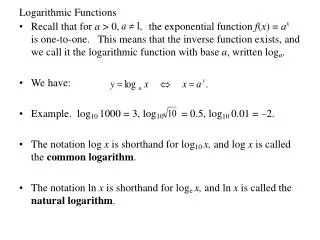
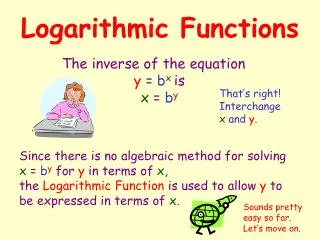
Definition • a is a positive number where a≠1 • The logarithmic function with base a is denoted by: • And is defined by
Forms • We can use this definition to switch between exponential form and logarithmic form exponent exponent base base
Evaluating Logarithms • Remember to switch between forms • If one form is true then so is the other • Evaluate log10100,000=5 b/c 105=100,000 log28=3 b/c 23=8 log2(1/8)=-3 b/c 2-3=1/8
Graphing Logarithmic Functions • Make a table of values • Ex: f(x)=log2x remember….2y=x
Translations of logarithms • Same rules apply!! • Vertical • Horizontal • Reflection over the x axis • Reflection over the y axis
Properties of Logarithms • loga1=0 • logaa=1 • Logaax=x • alogax=x
Common Logs • A log with base of 10 is called the common log • logx=log10x • Follow the same properties
Natural Logs • Logarithm with base e • ln x=logex • Properties: • ln 1=0 • lne=1 • ln ex=x • elnx=x
Graphing Natural Logs f(x)=ln(x) • Make a table of values
Translating natural log function • Vertical Translations • ln(x)±c • Horizontal Translations • ln(x±c) • Vertical Stretch/Compression • cln(x) • Horizontal Stretch/Compression • ln(cx) • Reflection over the x-axis • -ln(x) • Reflection over the y-axis • ln(-x) • Reflection over y=x • x=ln(y) ex=y
Practice/Hw • Practice • 8-3: p.108 # 1, 5, 13, 21, 30, 42, 50 • Hw • P. 405 #1-28