Download
1 / 14
140 likes | 274 Vues
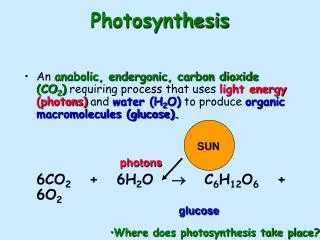
Photosynthesis is a crucial process carried out by autotrophs, converting sunlight into chemical energy to produce biomass. Utilizing chloroplasts, this process requires light absorption through chlorophyll. The light wavelengths absorbed play a significant role in energy conversion, yet photosynthesis is not highly efficient. Of the sunlight reaching leaves, only about 1% is utilized for photosynthesis while a substantial portion is either evaporated, reflected, or lost as heat. This overview elaborates on the main ingredients and mechanisms involved in photosynthesis.

E N D
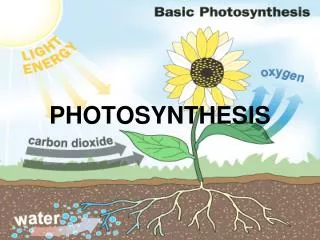
Photosynthesis producer, autotrophs, and the main Ingredients to make lots of biomass
Raw ingredients for Photosynthesis Light Leaf Pigment chloroplast
Leaf- specialized for light absorption Chloroplast- specialized for energy conversion: sun H+ gradient energy into ATP carbs
The above diagram show absorption of light by chlorophyll. Which wavelengths of light are absorbed? A. 400, 500, 600, 700 B. 400, 700 C. 450, 650 D. Yellow and Red E. Both C and D
Photosynthesis is not a very efficient process. Of the sunlight reaching the surface of a leaf, approximately how much is : • A. 75% is evaporated • B. 15% is reflected • C. 5% is transmitted through the leaf • D. 4% is converted to heat energy • E. 1% is used in photosynthesis
What observations can you make about this molecule? Polar or non polar? Why?
What wavelength of light is most effective for photosynthesis in filamentous green alga? Violet and Blue Blue and Orange Yellow and Green Orange and Red Red and Violet
Double membrane- Which is more similar to cell membrane, inner membrane or outer? Stroma- Grana- Thylakoid- Where is chlorophyll found? Where is light absorbed? What happens to light when its absorbed?