Download
1 / 9
90 likes | 212 Vues
This piece explores the complexities of American identity as depicted in the early 20th century. Israel Zangwill’s "The Melting Pot" illustrates the merging of diverse races into a unified American identity, while Randolph Bourne's critique highlights the failures of this ideal, suggesting that assimilation has not been fully realized. The voices of Martin Luther King, Jr. and contemporary cultural insights introduce themes of patience, disillusionment, and the irony present in modern American society. The struggle for true integration continues, reflecting the multifaceted nature of U.S. culture.

E N D
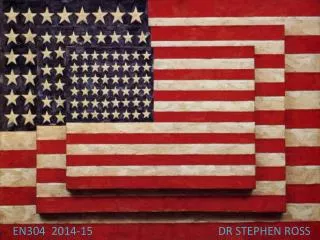
EN304 2014-15 DR STEPHEN ROSS
The Melting Pot “America is God's Crucible, the great Melting-Pot where all the races of Europe are melting and re-forming! […] Germans and Frenchmen, Irishmen and Englishmen, Jews and Russians—into the Crucible with you al!! God is making the American.” -Israel Zangwill, The Melting Pot (1908) Lower East Side, Manhattan, early 1900s
Or not. . . No reverberatory effect of the great war has caused American public opinion more solicitude than the failure of the ‘melting pot.’ Randolph Bourne, “Trans-National America” (1916)
For years now I have heard the word “Wait!” It rings in the ear of every Negro with piercing familiarity. This “Wait!” has almost always meant “Never.” Martin Luther King, Jr. “Letter from Birmingham City Jail” (1963)
The Feminine Mystique Is this all?
“When he was gone I was practically a prisoner in my own home!”
I want to convince you that irony, poker-faced silence, and fear of ridicule are distinctive features of contemporary U.S. culture (of which cutting-edge fiction Is a part) that enjoy any relation to the television whose weird pretty hand has my generation by the throat. DFW, “E UnibusPluram”