Download
1 / 8
80 likes | 219 Vues
This lesson focuses on equivalent fractions—fractions that represent the same value. Learn how to create equivalent fractions by multiplying or dividing the numerator and denominator by the same number. We explore the concept of simplifying fractions to their simplest form, where the numerator and denominator share no common factors other than 1. Users will practice finding the greatest common factor (GCF) and writing fractions in simplest form. Engage with examples and practice problems to reinforce your understanding of these essential mathematical concepts.

E N D
Equivalent Fractions Lesson 3-4
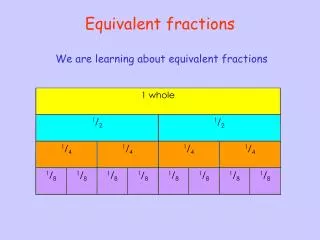
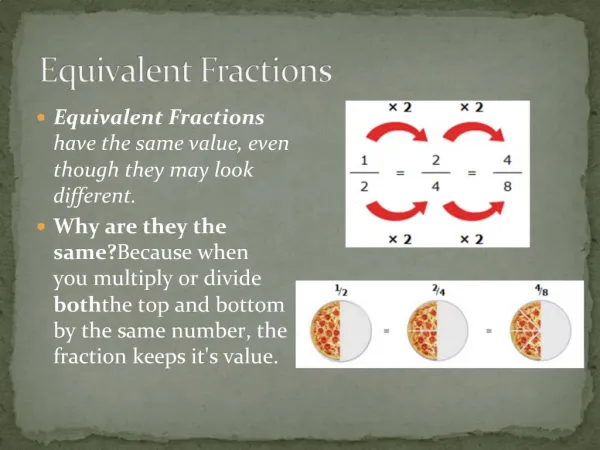
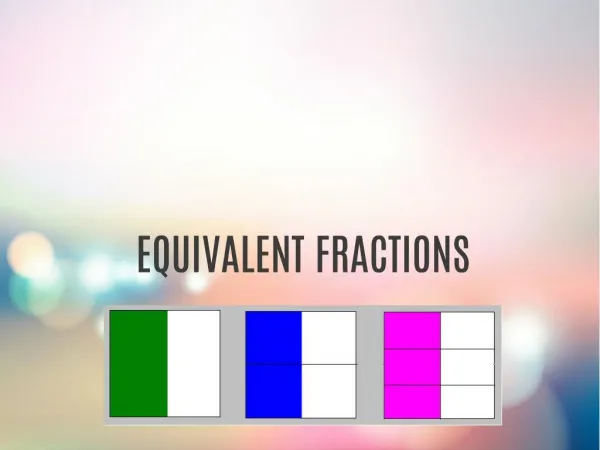
Vocabulary Equivalent fractions are fractions that name the same amount. 2 4 = 8 4
Creating Equivalent Fractions • Multiply the numerator and denominator by the same number. • Divide the numerator and denominator by the same number (it has to be a common factor to work with division) We can choose any number to multiply by. Let’s multiply by 2. 3 x 2 6 So, 3/5 is equivalent to 6/10. = x 2 10 5
If you have larger numbers, you can make equivalent fractions using division. Divide by a common factor. 4 28 ÷7 In this example, we can divide both numbers by 7. = 5 ÷7 35 28/35 is equivalent to 4/5.
Fractions in Simplest Form Fractions are in simplest form when the numerator and denominator do not have any common factors besides 1. Examples of fractions that are in simplest form: 4 2 3 8 5 11
Writing Fractions in Simplest Form. • Find the greatest common factor (GCF) of the numerator and denominator. • Divide both numbers by the GCF.
Example: 5 20 ÷ 4 = Simplest Form 7 ÷ 4 28 20: 1, 2, 4, 5, 10, 20 20 28 28: 1, 2, 4, 7, 14, 28 1 x 20 2 x 10 4 x 5 1 x 28 2 x 14 4 x 7 Common Factors: 1, 2, 4 GCF: 4 We will divide by 4.