
Understanding Capital Structures: NFP vs. For-Profit Organizations
E N D
Presentation Transcript
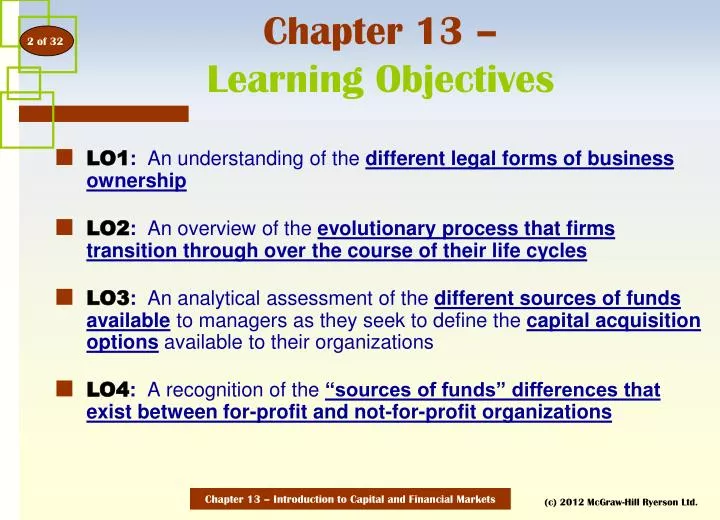
Chapter 13 – Learning Objectives 2 of 32 • LO1: An understanding of the different legal forms of business ownership • LO2: An overview of the evolutionary process that firms transition through over the course of their life cycles • LO3: An analytical assessment of the different sources of funds available to managers as they seek to define the capital acquisition options available to their organizations • LO4:A recognition of the “sources of funds” differences that exist between for-profit and not-for-profit organizations Chapter 13 – Introduction to Capital and Financial Markets (c) 2012 McGraw-Hill Ryerson Ltd.
NFP Source of Funds 29 of 32 LO4 • One of the key fundamental differences between not-for-profit (NFP) and for-profit organizations lies in their capital structure • NFPs can use cash available from operations as well as debt financing but not equity financing • However, many NFPs do not generate revenue but rely on funding totally from outside sources such as government; they are, in essence, expense-driven organizations • NFPs can fundraise; the concept of philanthropy and the ability to accept donations represents a core fundamental source of capital for many NFPs • Unlike their for-profit counterparts, NFPs in general will prefer to undertake philanthropic initiatives as a viable source of funds prior to exhausting current internal reserves or undertaking new debt • The achievement of its social mission and the delivery of its programs represents the NFP’s “raison d’etre” - it is the distribution of wealth and benefits through the NFP’s activities, even in the absence of generating a surplus, that must drive its management team’s decision-making focus Chapter 13 – Introduction to Capital and Financial Markets (c) 2012 McGraw-Hill Ryerson Ltd.