Understanding Universal Gravitation: The Attraction of All Objects in the Universe
160 likes | 288 Vues
This chapter delves into the principles of universal gravitation, emphasizing that all objects in the universe attract each other, including the moon and planets. Debunking the myth that celestial bodies are beyond Earth's gravity, we explore Newton's first law of motion and the role of gravitational forces. The chapter illustrates how the force of gravity varies with mass and distance, and provides problem-solving examples to calculate gravitational force on objects at different altitudes. Learn the fundamental concepts behind gravitational attraction and their real-world applications.


Understanding Universal Gravitation: The Attraction of All Objects in the Universe
E N D
Presentation Transcript
All objects in the Universe attract each other • True or False: The moon and planets are beyond the pull of Earth’s gravity.
All objects in the Universe attract each other • True or False: The moon and planets are beyond the pull of Earth’s gravity. FALSE!!!
Lets consider the moon and Newton’s first law • An object in motion will remain in motion in a straight line unless acted on by an outside force. • What is the outside force working on the moon?
Lets consider the moon and Newton’s first law • An object in motion will remain in motion in a straight line unless acted on by an outside force. • What is the outside force working on the moon? Gravitational Attraction
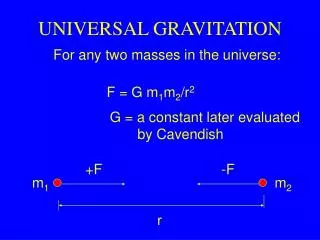
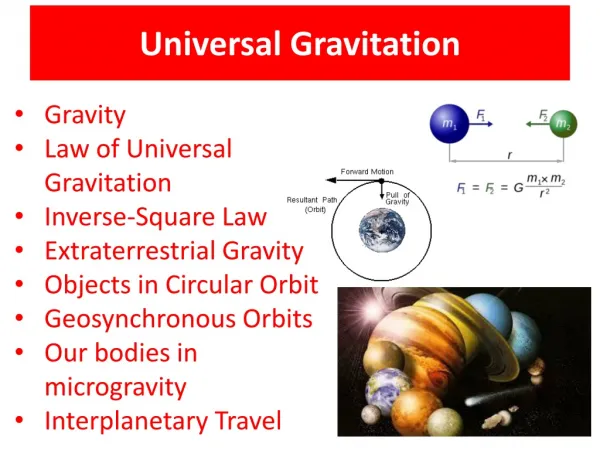
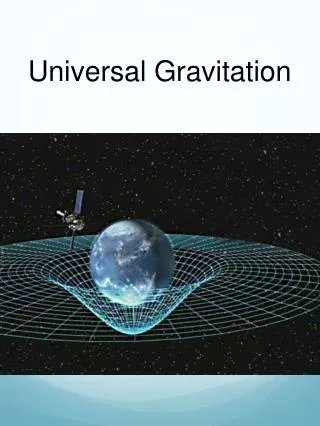
Force of Gravity (Fg ) • If two objects have masses, m1 and m2, with center of mass separated by distance, r, then, each object exerts an attractive force on the other. Formula for Universal Gravitation Fg = G m1m2 r2 G is the Universal Gravitation constant 6.67 x 10 -11 N·m2 kg2
Force of Gravity (Fg ) Fg = G m1m2 r2 With increasing altitude or distance, r, what happens to the Force of Gravity (Fg )?
Force of Gravity (Fg ) Fg = G m1m2 r2 With increasing altitude or distance, r, what happens to the Force of Gravity (Fg )? It Decreases!!!
Force of Gravity (Fg ) Fg = G m1m2 r2 How is Fg affected when: Mass 1 is doubled? When both mass 1 and mass 2 are doubled? When the masses are 2x as far apart? When they are 3 x as far apart?
Force of Gravity (Fg ) Fg = G m1m2 r2 How is Fg affected when: Mass 1 is doubled? Fgis doubled When both mass 1 and mass 2 are doubled? Fgis quadrupled (4x) When the masses are 2x as far apart? Fgis decreased by ¼ When they are 3 x as far apart? Fgis decreased by 1/9
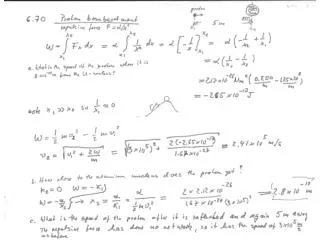
Problem Solving: Calculate the force of gravity on a 3 kg mass at Earth’s surface. The mass of earth is 6 x 1024 kg and Earth’s radius is 6.4 x10⁶ m. Fg = G m1m2 G= 6.67 x 10 -11 N·m2 r2 kg2
Problem Solving: Calculate the force of gravity on a 3 kg mass at Earth’s surface. The mass of earth is 6 x 1024 kg and Earth’s radius is 6.4 x10⁶ m. Fg = G m1m2 G= 6.67 x 10 -11 N·m2 r2 kg2 F = (6.67 x 10 -11 N·m2/kg2)(3 kg) (6 x 1024 kg ) (6.4 x10⁶ m)2 F = 29.31 N
Calculate the Force of Gravity on a 3 kg object 6.4 x 10⁶ m above the Earth’s surface.
Calculate the Force of Gravity on a 3 kg object 6.4 x 10⁶ m above the Earth’s surface. F = (6.67 x 10 -11 N·m2/kg2)(3 kg) (6 x 1024 kg ) (6.4 x10⁶ m + 6.4 x10⁶ m )2 F = 7.3 N
Law of Universal Gravitation PRACTICE