Download

1 / 16
160 likes | 288 Vues
This comprehensive guide explores the essential concepts of acids and bases in chemistry. It covers acid nomenclature, including common acids like hydrochloric acid (HCl), sulfuric acid (H2SO4), and nitric acid (HNO3). Key properties of acids and bases are discussed, such as their tastes, reactions, and pH indicators. Definitions from various theories, including Arrhenius, Brønsted-Lowry, and Lewis, highlight the behavior of acids and bases. Additionally, distinctions between strong and weak electrolytes clarify their ionization in solutions. Perfect for students and chemistry enthusiasts!

E N D
Ch. 18 – Acids & Bases I. Introduction toAcids & Bases
Review – Naming Acids • HCl • H2S • H2SO4 • H2SO3 • HNO3 • HNO2 • HBr • Hydrochloric acid • Hydrosulfuric acid • Sulfuric acid • Sulfurous acid • Nitric acid • Nitrous acid • Hydrobromic acid
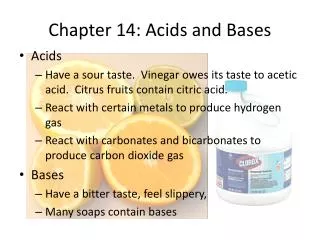
electrolytes electrolytes A. Properties ACIDS BASES • bitter taste • sour taste • turn litmus red • turn litmus blue • react with metals to form H2 gas • slippery feel • vinegar, milk, soda, apples, citrus fruits • ammonia, lye, antacid, baking soda
HF H3PO4 H2SO4 B. Definitions • Monoprotic – an acid with one H+ • Polyprotic – an acid with more than one H+ • Diprotic – an acid with 2 H+ • Triprotic – an acid with 3 H+ monoprotic triprotic diprotic polyprotic
H H – + O O Cl Cl H H H H B. Definitions • Arrhenius • Acids contain hydrogen • Acidsform hydronium ions (H3O+) in aqueous solution HCl+ H2O H3O+ + Cl– acid
B. Definitions • Arrhenius • Bases contain a hydroxide group • Bases form hydroxide ions (OH-) in aqueous solution H2O NaOH Na+ + OH- base
conjugate base conjugate acid B. Definitions • Brønsted-Lowry • Acidsare proton (H+) donors • Bases are proton (H+) acceptors HCl + H2O Cl– + H3O+ acid base
conjugate base conjugate acid B. Definitions • Brønsted-Lowry • Conjugate Acidsare the result after a base accepts a hydrogen ion • Conjugate Bases are the result after an acid donates a hydrogen ion HBr + NaOH NaBr + H2O acid base
B. Definitions H2O + HNO3 H3O+ + NO3– B A CA CB H2O + NH3 NH4+ + OH- B CA CB A • Amphoteric – can be an acid or a base
F - H2PO4- H2O HF H3PO4 H3O+ B. Definitions • Give the conjugate base for each of the following: • Polyprotic – an acid with more than one H+
Br - HSO4- CO32- HBr H2SO4 HCO3- B. Definitions • Give the conjugate acid for each of the following:
B. Definitions • Lewis • Acidsare electron pair acceptors • Bases are electron pair donors Lewis base Lewis acid
- + C. Strength • Strong Acid/Base • 100% ionized in water • strong electrolyte NaOH KOH KOH RbOH CsOH Ca(OH)2 Ba(OH)2 HCl HNO3 H2SO4 HBr HI HClO4
- + C. Strength • Weak Acid/Base • does not ionize completely • weak electrolyte HF CH3COOH H3PO4 H2CO3 HCN NH3