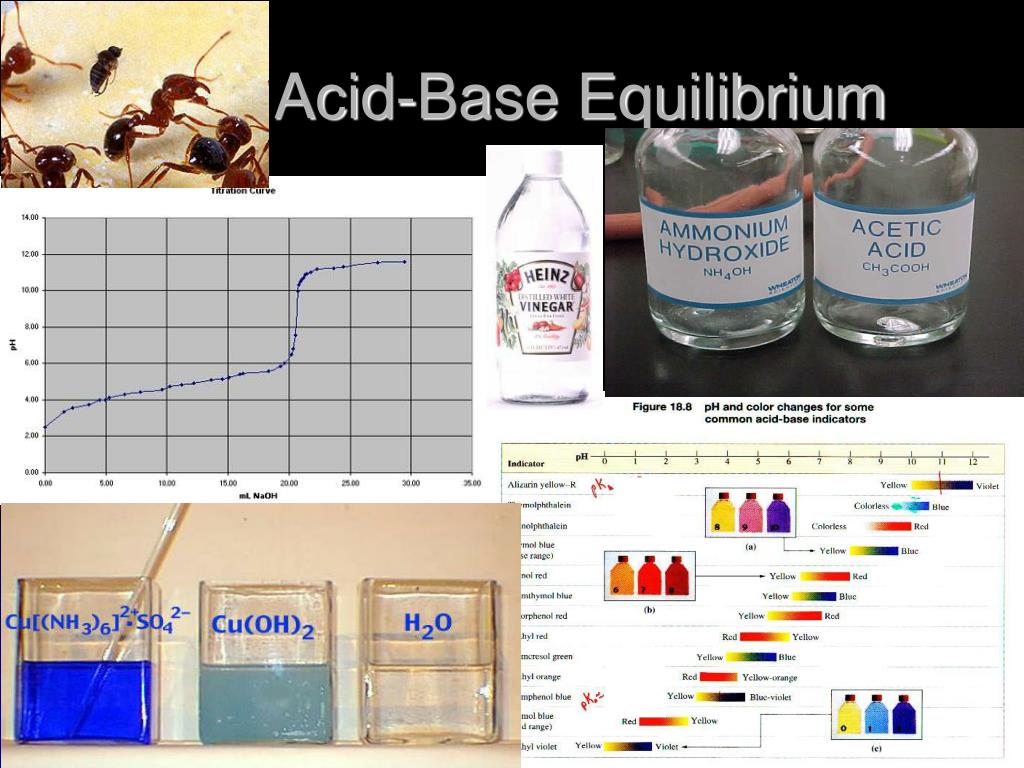
Acid-Base Equilibrium. What You’ll See. Tie together concepts of acids and bases and equilibrium Weak acids and related calculations Weak bases and related calculations Salt solutions (acid-base properties) Hydrolysis Common Ion Effect Buffers & Henderson-Hasselbalch equation
Une image / un lien ci-dessous est fourni (tel quel) pour télécharger la présentation
Politique de téléchargement : le contenu du site vous est fourni TEL QUEL pour votre information et votre usage personnel ; il ne peut être vendu, concédé sous licence ni partagé sur d’autres sites sans l’accord de son auteur.Le contenu vous est fourni TEL QUEL, pour votre information et votre usage personnel uniquement.Téléchargez la présentation en cliquant sur ce lien.Lors du téléchargement, si vous ne parvenez pas à télécharger une présentation, l’éditeur a peut-être supprimé le fichier de son serveur.Pendant le téléchargement, si vous ne parvenez pas à obtenir une présentation, le fichier a peut-être été supprimé par l’éditeur.
What You’ll See • Tie together concepts of acids and bases and equilibrium • Weak acids and related calculations • Weak bases and related calculations • Salt solutions (acid-base properties) • Hydrolysis • Common Ion Effect • Buffers & Henderson-Hasselbalch equation • Titrations
Weak Acids • Only slightly ionized • A real equilibrium situation • Examples include • Organic acids (acetic, lactic, formic) • Inorganic where # O exceeds # H by <2 (phosphoric, carbonic, nitrous acids)
Weak acids • Since they are only slightly ionized we can write the process and an equilibrium expression. • For example, for HF it would be • HF + H2O H3O+ + F- (or HF H+ + F-) • Ka (= Keq for acids) = [H3O+][F-] [HF] We can do several calculations with this(!)
Find Ka from pH • Continue with HF example • A solution of 0.015 M HF has a pH of 2.89. Find the value of Ka for hydrofluoric acid. • A 0.015 M HF solution was made to have 0.015 moles HF/L. A small % of that weak acid ionizes so at equilibrium there is slightly less than 0.015 mole/L. • We can figure this out with an ICE chart
HF + H2O H3O+ + F- Initial 0.015 0 0 Change -x +x +x Equilibrium 0.015-xx x (we get to leave water out of equilibrium calculations) We need x the [H3O+]. If the pH = 2.89, then [H3O+] = 10-2.89 = 1.29 x 10⁻³M Plug that back into the chart
HF H3O+ + F- Initial 0.015 0 0 Change -0.00129 +0.00129 +0.00129 Equilibrium 0.0137 0.00129 0.00129 Plug back into the Ka expression and get Ka = (0.00129)(0.00129)/(0.0137) = 1.2 x 10⁻⁴ A small Ka value is what you’d expect for a weak acid (few ions or primarily in un-ionized form) What percent is ionized? (0.00129)/0.015 =0.086 = 8.6 % (far less than the 100% for a strong acid).
Solving Ka, given the pH • The pH of a .85M solution of acetic acid is 2.75. What is Ka for acetic acid • It helps to abbreviate the acid HAc instead of writing out the entire formula • HAc H+ + Ac- • Ka = [H+][Ac-] [HAC]
Start, change, equilibrium HAc H+ + Ac- Start .85M 0 0 Change -x +x +x Equilibrium .85-x x x But x =[H+], which we know since we know the pH and [H+] = 10-pH = 10-2.75 = 2 x 10⁻³
Continuing HAc H+ + Ac- Start .85M 0 0 Change -x +x +x Equilibrium .85-x x x Or .848 .002 .002 Ka = (.002)(.002) .848 = 4.7 x 10⁻⁵
Using Ka to get pH • What are the concentrations of H+, F- and HF as well as the pH in a .14M solution of HF? • If this were a strong acid we could know that [H+] was .14M and it would be a simple problem • Alas, that is not the case
Plan of Attack • Write an equilibrium expression • Do an ICE table • Solve for unknowns • Hint- you will be given Ka (6.7 x 10⁻⁴)
HF H+ + F- Initial .14 0 0 Change -x +x +x Equilibrium .14-x x x Ka = 6.7 x 10-4 = [H+][F-] [HF] And it looks like we need the quadratic…
But… 6.7 x 10-4 = (x)(x) (.14-X) If x is small (and it should be for a weak acid) then .14-x is just about .14 This has two benefits • It simplifies the math • It annoys math teachers
So now we get… 6.7 x 10-4 = x2 .14 X2 = 9.4 x 10⁻⁵ X = [H+] = [F-] = 9.7 x 10⁻³ So pH = -log(9.7 x 10⁻³) = 2.01 And [HF] = .14-.0097 = .13 so it was a pretty good approximation
When can you use that approximation? ( I hear you ask) • In this class almost always, provided you make it clear that you are using a an approximation and that you know it is justified • It is justified when [HA]/Ka >100 • This leads to less than a 5% error
% Ionization of a weak acid • Benzoic acid is a weak, monoprotic acid. A .0135M solution of benzoic acid has a pH of 3.27. What % of the benzoic acid molecules are ionized? What is Ka? • Write the equilibrium equation • Write the Ka expression • Do ICE • solve
% Ionization of Benzoic Acid HBz H+ + Bz- We often abbreviate formulas like this to let us focus on the ions that are really important to the problem. Ka = [H+][Bz-] [HBz]
Start, change, equilibrium HBz H+ + Bz- Initial .0135 0 0 Change -x +x +x Equilibrium .0135-x x x X = [H+] = 10-3.27 = 5.37 x 10⁻⁴ .0135-x = .0130 (ignoring it would be a 4% error –not necessary b/c you don’t need the quadratic to solve this.
Wrapping it up • Ka = (5.37 x 10⁻⁴)2 .0130 • = 2.2 x 10⁻⁵ • % ionized = x/[HBz]0 = • 5.37 x 10⁻⁴/.0135 = .040 = 4%
Polyprotic Acids • Acids with more than one “donatable”ton • Diprotic • Sulfuric acid • Carbonic acid • Triprotic • Phosphoric acid
Qualitative Approach • In general, the second proton Ka value is much less (factor of 10000 or so) than the first proton’s Ka value • This means you can “usually” ignore the contribution from the ionization of the second hydrogen
Example H2SO3 H+ + HSO3- Ka = 1.3 x 10⁻² HSO3- H+ + SO3-2 Ka = 6.3 x 10⁻⁸ Because Ka2<<Ka1 the contribution of the second ionization of hydrogen to the total [H+] is minimal One exception is sulfuric acid Ka for HSO4- = 1.2 x 10⁻² Example to follow:
pH of .01 M H2SO4 • We know that the contribution of hydrogen ions from the ionization of H2SO4 is .01M (strong acid: 100% ionized) • For the second ionization of H: • HSO4- H+ + SO4-2 Ka = 1.2 x 10⁻² • Set up an initial, change, equilibrium table
HSO4- H+ + SO4-2 Iniial .010 .010 0 Change -x +x +x Equilibrium .010-x .010 +x x Note that bisulfate ion and hydrogen ion are not initially zero because of the ionization of H2SO4 Write the Ka (equilibrium) expression
HSO4- H+ + SO4-2 Ka = [H+][SO4-2] [HSO4-] 1.2 x 10-2 = (.010+x)(x) (.010-x) After a “twist of algebra” you’ll get x =4.5 x 10⁻³ so that the total [H+] = 1.4 x 10⁻² and the pH = 1.85 Since there should be more ions than from just the first ionization (.01M H+), the pH should be slightly less than 2, which it is.
Polyprotic Wrap-Up • Other than that one example, the contribution to the total amount of hydronium ion from the second (or third) hydrogen of a polyprotic acid is so small that we can ignore it. The ffect on the pH is even less since it involes the log of the [hydronium ion]
Weak Base Equilibria • Weak Bases • Few ions • Accept protons • Lead to an increase in hydroxide ions • Involve a Kb expression • Must write as a reaction water (water will act as the Bronsted-Lowry acid)
Sample #1 • Find the pH of a .0035M solution of quinine, a naturally occurring weak base once used to treat malaria. Kb for quinine is 3.3 x 10⁻⁶. • Write the ionization equation & Keq (or Kb) expression
Abbreviate quinine Qu Qu + H2O HQu+ + OH- Initial .0035 0 ~0 Change -x +x +x Equilibrium .0035-x x x (there are a few OH- ions in pure water) Kb = [HQu+][OH-] [Qu] Substituting in give…
3.3 x 10-6 = (x)(x) (.0035-x) Since [base]/Ka>>100 it is safe to approximate .0035-x = .0035 A bit of algebra and we get x = 1.1 x 10⁻⁴ Remember that x = [OH-] Then get [H+] = 1 x 10-14/1.1 x 10-4 Give [H+] = 9.1 x 10⁻¹¹ and pH = -log (9.1 x 10⁻¹¹) = 10.0 Which is reasonable for a base
Let’s do one more! • The pH of a .0025M solution of hydrazine (N2H4) is 9.92. What is Kb for hydrazine? • N2H4 + H2O N2H5+ + OH- Kb = [N2H5+][OH-] [N2H4]
Hydrazine cont’d N2H4 + H2O N2H5+ + OH- Initial .0025 0 ~0* Change -x +x +x Equilibrium .0025 –x x x (*I should have been doing ~0 for the initial [H+] in acids as well)
Since the pH is 9.92, the [H+] = 10-9.92= 1.20 x 10⁻¹⁰M Then we can get [OH-] =8.33 x 10⁻⁵M Substituting we get Kb = (8.33 x 10⁻⁵)(8.33 x 10⁻⁵) (.00242) = 2.9 x 10⁻⁶
Wrap-Up • Follow a similar strategy as acids • Keep in mind that if it is a base, you will be solving for hydroxide ion concentration • pH must be >7 (quick check) • Write ionization equation (water acts as the Bronsted-Lowry acid) • Write Kb, plug in and solve
Salt Solutions- Acid/Base Properties • Salts can be thought of acid being the product of an acid-base neutralization • Salts can be acidic, basic or neutral • We will approach salt solutions first • Qualitatively and then • Quantitatively
First • You need to be able to look at a salt and decide what acid and base its ions could have come from (this is not the same as saying that every salt is made by an acid-base rxn) • Positive ion will be from the base • Negative ion will be from the acid
A couple of examples • NaCN • Sodium hydroxide and hydrogen cyanide • K3PO4 • Potassium hydroxide and phosphoric acid • LiBr • Lithium hydroxide and hydrobromic acid • NH4NO3 • Ammonia and nitric acid (think of ammonia as ammonium hydroxide if it helps)
Qualitative Approach • Great for multiple choice Q’s • A good way to check when you do the quantitative ones later • See table on next slide for a quick summary • Note how recognizing the strong and weak acids is vital
Yes It Depends • It has been a while since this was the answer to a question • So the more ionized the weak acid or base the “stronger” a weak acid or base it will be • If Ka>Kb it will be an acidic salt • If Kb>Ka it will be a basic salt
More on “it depends” • Recall that all strong acids and bases are equally ionized (100%) • But weak acids and bases may range from 10% ionized to barely .01% ionized • All strong acids and bases are equally strong • The same is not true for weak acids and bases
Quantitative Approach • Consider a solution of NaF (science problems always begin with “consider…” as in “consider a spherical chicken with radius r…”) • NaF Na+ + F- (100% ionized) • Na+ ion is nonreactive with water (it is stable when hydrated) • F- ion can react with water
Hydrolysis (that’s the name of it) F- + H2O HF + OH- This means that the solution should be basic (strong base and weak acid salt) This reaction between the ion of a weak acid or base and water is called hydrolysis
Hydrolysis Kb for F- = Kw/Ka for HF (book does you the “service” of going through the derivation) Kb = 1 x 10-14/6.8 x 10-4 = 1.5 x 10⁻¹¹ This can then be used to calculate [OH-] and then [H+] and pH As we see in the next few slides
Find the pH of a .4M NaF sol’n NaF Na+ + F- F- + H2O HF + OH- Kb = 1.5 x 10⁻¹¹ (see previous slide) Kb = [HF][OH-] [NaF] Set up an initial, change, equilibrium table (NaF = F-)
F- + H2O HF + OH- Initial .4M 0 ~0 Change -x +x +x Equilibrium .4-x x x Kb = 1.5 x 10-11 =[HF][OH-] [NaF] 1.5 x 10-11 = (x)(x) (.04-x)
Wrapping it Up… • Since [NaF]/Kb >100 we can approximate .4-x as .4 and get • 1.5 x 10-11 = x2/.4 • X = [OH-] = 2.4 x 10⁻⁶ • [H+] = 1 x10-14/2.4 x 10-6 = 4.1 x 10⁻⁹ • pH = 8.3 (basic as we would predict) • One more
Morphine is a weak base used for relief of severe pain. Morphine is not soluble in water, but morphine chloride is. What is the pH of a .100M solution of Morphine chloride (MorCl)? Kb for morphine is 1.6 x 10⁻⁶ • Plan- first do qualitatively (acidic) • Ionization equation & hydrolysis equation • Start, change, equilibrium • Ka from Kb, then [H+]
MorCl Mor+ + Cl- • Cl- is the ion of a strong acid (nonreactive) • Mor+ undergoes hydrolysis with water • Mor+ + H2O H3O+ + Mor • (H3O+ = H+) • Ka = Kw/Kb = 6.3 x 10⁻⁹ • Ka = [H3O+][Mor] [Mor+]
Connexion au compte
Connectez-vous pour publier votre contenu sur SlideServe.