Download
1 / 4
40 likes | 176 Vues
This research project focuses on developing innovative electrochemical approaches for forming deep through-silicon vias. It includes studies on TiO2 photocatalysts for CO3 reduction and evaluating Li-ion battery materials using silicon nanowires. The aim is to enhance biological interfaces and sensors through silicon nanowire functionalization, while also exploring ionic liquid behavior within nanoporous carbons to optimize designs for electrochemical capacitors and dye-sensitized solar cells. Additional work includes controlling carbon nanotube orientation using liquid crystals for improved electronic applications.

E N D
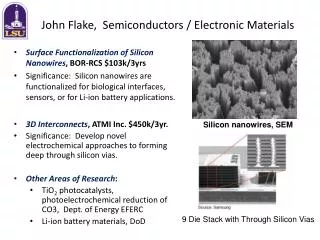
John Flake, Semiconductors / Electronic Materials • 3D Interconnects, ATMI Inc. $450k/3yr. • Significance: Develop novel electrochemical approaches to forming deep through silicon vias. • Other Areas of Research: • TiO2 photocatalysts, photoelectrochemical reduction of CO3, Dept. of Energy EFERC • Li-ion battery materials, DoD Silicon nanowires, SEM 9 Die Stack with Through Silicon Vias Surface Functionalization of Silicon Nanowires, BOR-RCS $103k/3yrs Significance: Silicon nanowires are functionalized for biological interfaces, sensors, or for Li-ion battery applications.
Francisco R. Hung, Molecular Modeling in Materials Design Ionic Liquids in Nanoporous Carbons: when confined, how are the ionic liquids affected by the properties (pore size, pore morphology, surface chemistry) of the carbons? Significance: optimize design of (1) electrodes for electrochemical double layer capacitors (EDLCs) for hybrid vehicles; and (2) nanoporous semiconductors (e.g., TiO2) for dye-sensitized solar cells (DSSCs) for using solar energy (with John Flake) Electric double-layer capacitor Organization of Carbon Nanotubes Using Liquid Crystals:investigate the use of liquid crystals (LCs) to manipulate and control the orientation of carbon nanotubes (CNTs) Significance: high-quality dispersions of oriented CNTs in LCs have applications in displays, nanoscale electronics, optical sensors, and in the development of composites with unique mechanical, thermal and/or electronic properties. Dye-sensitized solar cell Wall patterned arrays that might be used to align CNTs dispersed in a LC
Greg Griffin, Materials Processing Aerosol synthesis methods Significance: (1) Aluminum nitride powder - thermal heat sink, ceramic armor; (2) Sol-gel / colloidal chemistry – mesoporous TiO2 - photocatalytic air, water purification. Chemical vapor deposition / Atomic layer deposition Significance: copper thin films – microelectronic circuitry (CVD) palladium nanoparticles - heterogeneous catalysis (ALD) Future plans Nanostructured catalyst preparation Significance: CO2 conversion; desulfurization; - photocatalytic decontamination Microelectronic devices Metallization circuitry; solar photovoltaic cells Environmental nanotechnology - education proposal
Kerry Dooley, Catalytic Materials Monolithic Materials for Oscillating Reactors (C. Knopf) Significance: Enhanced observed rates in catalysis of edible oil hydrogenation, oxidative desulfurization. Mixed Rare Earth Oxides for Nanocombustion and Desulfurization (S. Acharya) Significance: Enhanced thrust for fighter aircraft; desulfurization and tar removal from coal and biogasifier effluents. Figure – Synthetic Evolution of Four Generations of High-Temperature (600ºC) Oxide Desulfurization Sorbents Hydrodeoxygenation/ Decarboxylation of Fatty Acids and Rosin Acids Significance: Biorefining the acids fraction of pyrolysis liquids and tar extracts to higher value fuels, chemicals