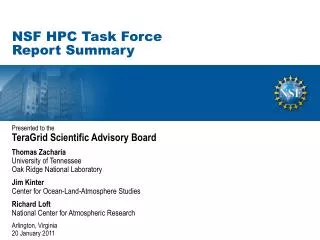
NSF HPC Task Force Report Summary
NSF HPC Task Force Report Summary. Presented to the TeraGrid Scientific Advisory Board Thomas Zacharia University of Tennessee Oak Ridge National Laboratory Jim Kinter Center for Ocean-Land-Atmosphere Studies Richard Loft National Center for Atmospheric Research

NSF HPC Task Force Report Summary
E N D
Presentation Transcript
NSF HPC Task Force Report Summary Presented to theTeraGrid Scientific Advisory Board Thomas ZachariaUniversity of TennesseeOak Ridge National Laboratory Jim KinterCenter for Ocean-Land-Atmosphere Studies Richard LoftNational Center for Atmospheric Research Arlington, Virginia20 January 2011
HPC Task Force: Charter • Provide specific advice on the broad portfolio of HPC investments that NSF should consider • Time span: 5–10 years • Scope: • Cyberinfrastructure to support research • Research on cyberinfrastructure (hardware and software) • Training
HPC Task Force: Activities • 3 community workshops (Arlington, Virginia): University, industry, and government participants • Sustainability and User Requirements, 4 December 2009 • Applications at the Exascale, 29 July 2010 • Broader Engagement, 3 December 2010 • Community input solicited • Presentations, reports, and position papers posted:http://www.nics.tennessee.edu/workshop
Sustainability and User Requirements Workshop: 4 December 2009 38 attendees
Sustainability and User Requirements:Recommendations for NSF
Applications at the Exascale Workshop: 29 July 2010 44 attendees
Applications at the exascale:Recommendations for NSF • Expand partnerships with industry, academia, and other agencies to accelerate development of exascale systems and applications • Co-design will be critical in development of applications that can deliver predictive capability • Expand efforts to engage new user communities in HPC • Focused outreach program to industry • Engagement of data-intensive fields of research • Provide a funding framework for co-location of archive and community data resources with compute and visualization resources • Establish a continuing process for soliciting community input on plans for HPC investments
Broader Engagement Workshop: 3 December 2010 41 attendees
Broader Engagement:Preliminary recommendations to NSF • Continue and grow education, outreach, and training programs to expand awareness and encourage use of high-end modeling and simulation capabilities • Industry • New user communities • Expanded workforce development programs, starting with K–12 • Measure program impacts • Expansion in use of HPC • Delivery of science • Consider establishment of a computational science program or division
HPC Taskforce:Summary recommendations to NSF • Develop asustainablemodel to provide the academic research community with access, by 2015–2016, to a rich mix of HPC systems that: • Deliver sustained performance of 20–100 petaflops on a broad range of science and engineering applications • Are integrated into a balanced, comprehensive, national cyberinfrastructure environment • Are supported at national, regional, and/or campus levels • Invest now to prepare for exascale systems that will be available by 2018–2020 • Co-design partnerships • Data cyberinfrastructure(networking, disk, and storage) for data-driven science • Broaden outreach to include industry and new user communities • Establish a continuing process for soliciting community input on plans for HPC investments