Download
1 / 11
110 likes | 255 Vues
This chapter explores the essential concepts of acids and bases, including ionization, qualities, and the pH scale. It delves into the comparison of acidity in various substances, illustrating how to assess strength versus concentration, particularly through molarity and titration methods. Additionally, the significance of pH in physical health and its balance in foods is discussed. The chapter highlights the practical implications of acid-base reactions, such as neutralization, and the role of buffers in maintaining pH balance within the body.

E N D
Acids and Bases Chapter 10
Objectives • Relate the process of ionization to the formation of acids and bases • Explain qualities of acids and bases • Compare the acidity of substances, using the pH scale and pH indicators • Use molarity and titration to determine the concentration of an acid • Contrast the concepts of strength and concentration in acids and bases • Compare general qualities of acids and bases in foods • Explain the importance of pH to physical health
Vocabulary • Ionization: the process of forming ions in water solution • Neutral: a solution that has an equal number of hydrogen and hydroxide ions • Acid: a substance that breaks down to release hydrogen ions in water • Base: a substance that breaks down to release hydroxide ions in water • Neutralization: a chemical reaction in which hydrogen ions from an acid react with hydroxide ions from a base to produce water • pH scale: a mathematical scale in which the concentration of hydrogen ions in a solution is expressed as a number from 0 to 14 • Indicator: a substance that changes color depending on the pH • Concentration: the measure of the amount of a substance in a given unit of volume • Molarity: the number of moles of solute per liter of solution • Titration: a common method used in the laboratory to determine the concentration of an acid and base • Equivalence point: the point at which neutralization occurs • Buffers: substances that help maintain the balance of hydrogen and hydroxide ions in a solution
Acids and Bases Video • http://www.youtube.com/watch?v=DupXDD87oHc
Ionization of Water • In water, a very small portion of molecules form tiny charged particles called ions • When water ionizes, both hydrogen (H+) and hydroxide (OH-) ions are formed H2O ↔ H+ + OH -
Strength of Acids and Bases • Strong acids and bases ionize completely • Strong acid example: hydrochloric acid • Weak acids and bases ionize partially • Weak acid example: Acetic acid, found in potato salad
Neutralization of Acids and Bases • If you add base to an acid, it adds hydroxide ions • becomes a weaker acid and raises the pH • If you add acid to a base, it adds hydrogen ions • becomes a weaker base and lowers the pH • Neutralization occurs when there are equal numbers of hydrogen and hydroxide ions
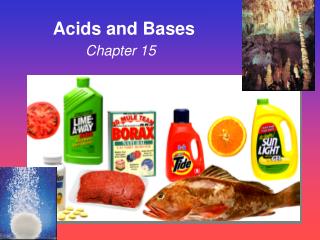
General Properties • Acids • Sour taste (ex: lemons) • Can change the colors of certain foods and flowers (ex: Hydrangeas turn blue when planted in acidic soil) • Bases • Bitter taste (ex: milk of magnesia) • Slippery (ex: soap, ammonia)
pH Scale • Acids: pH between 0 and 7 • Lower pH numbers indicate stronger acid • Bases: pH between 7 and 14 • Higher pH numbers indicate stronger bases • Neutral: pH of 7 • Determined by indicators and meters • Ex: litmus paper soaked in anthocyanin
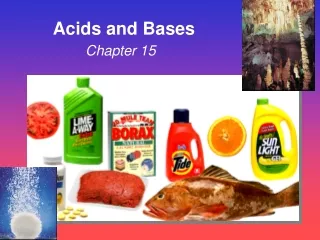
Acids and Bases in Foods • Most bases in foods are strong, but with low concentration, so they are safe • Most acids in foods are weak acids, so they are generally safe • May sting eyes or open cuts (ex: citrus fruits) • Very few foods have pH of exactly 7 • Except distilled water • pH balance is essential in making baked goods rise
Acids and Bases in the Body • Blood must have balanced pH • Not affected by pH of foods • Regulated by buffers • Digestive system requires a highly acidic environment to digest food • Between 1.5 and 1.7 pH • Gastric acid is mostly hydrochloric acid • Antacids help neutralize stomach acid