Convergence Testing and Failure Analysis of Quadrilateral and Tetrahedral Finite Element Models
This study explores the modeling procedures for planar 8-noded quadrilateral and 10-noded tetrahedral elements in finite element analysis. Convergence testing was performed on meshes with fewer than 2000 elements, revealing inconsistencies in results. Experimental strain testing was conducted using an Instron machine, and photoelastic comparisons showed that predicted stress concentrations aligned closely with experimental outcomes. The failure analysis indicated that loads exceeding the manufacturer-rated limit of 12.5 kN resulted in significant plastic deformation, highlighting the importance of material specifications in stress analysis.

Convergence Testing and Failure Analysis of Quadrilateral and Tetrahedral Finite Element Models
E N D
Presentation Transcript
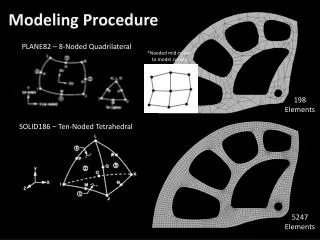
Modeling Procedure *Needed mid-nodes to model curves PLANE82 – 8-Noded Quadrilateral 198 Elements SOLID186 – Ten-Noded Tetrahedral 5247 Elements
Convergence Testing Performed To Ensure Model Precision Meshes under 2000 elements exhibited inconsistent results Mesh 1 1749 Elements Mesh 6 348 Elements Mesh 7 305 Elements Mesh 9 198 Elements Mesh 5 424 Elements Mesh 3 919 Elements Mesh 2 1239 Elements Mesh 4 640 Elements Mesh 1-Refined 5247 Elements
Experimental Strain Testing Averaged Elemental Equivalent Stresses over Gauge Region Applied Load in Instron Machine
Photoelastic Comparison Created photoelastic model of cam lobe from clear polymer Simulated loading in Photoelastic Apparatus Stress concentrations closely matched FE predictions
Photoelastic Comparison Hard to simulate photoelastic stress fringes General stress fields similar Would have more success with Material specifications
Failure Analysis Stress Results for 12.5 kN (2800 lb) Loads Exceeding 12.5 kN were found to cause excessive plastic failure Main failure regions were not in the arches Manufacturer Rating: 14.4 kN UIAA Standards require 12 kN rating for rope 20 kN (4500 lb) 15 kN (3350 lb) 30 kN (6750 lb)