Download

1 / 9
90 likes | 237 Vues
This resource delves into the essential aspects of body organization, focusing on tissues and anatomical planes. It categorizes the four main tissue types: epithelial, muscle, nervous, and connective, highlighting their functions and classifications. Key concepts include the differentiation between hard and soft connective tissues, the importance of muscle in movement, and the role of nerves in message transmission throughout the body. Additionally, the document explains the body's planes—coronal, transverse, and sagittal—as well as essential terms such as proximal and distal, providing a comprehensive foundation for understanding human anatomy.

E N D
Body Organization and Planes Ayo Gbadehan Shawn M. McCullough
Body Organization • 4 types of tissue • epithelial • muscle • nervous • connective
Body Organization • Connective-classified as hard or soft • Epithelial- located in the lining inside of the nose • Nerves- Transmits messages from head to the toes • Muscle-primary use is to produce movement • Ex: of muscle tissue: Smooth Ex: heart
Body Organizations • Tissue facts –. • Atom is the most building block of the cell • The kidney is way more complex than the nerve cell, or muscle tissue, or a nucleus. Come on, get it together you should know this • Tissue fluid excess causes edema, while lack of fluid results in Dehydration
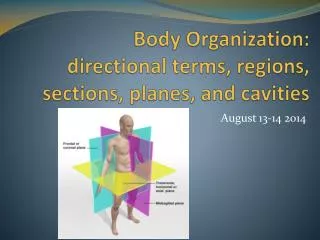
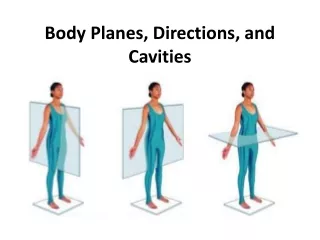
Body Planes- • The coronal region is separated into posterior and anterior regions. • The transverse is separated into the inferior and superior regions. • The bladder is in the inferior • The sagittal plane separates left and right.
Body planes • Distal – away from the center or point of origin • Proximal – near the center or point of origin
Terms • Lateral-toward the side • Anterior-the front • Frontal-front of the head • Ventral-the underside or abdominal • An x-ray labeled ventral view is the front of the patient • Proximal-closer to the body